Tuesday, January 31, 2017

Mesothelioma


Back in 2013, I was contacted by Cameron Von St. James. He came across An Arkie's Musings, and saw that fighting back against cancer was a priority here. He contacted me and offered to tell his story to my readers. We corresponded and he sent me his story. It is both compelling and informative.

I posted his story on An Arkie's Musings and then wrote a blog post that was an update on his story a few month later.

Not long ago I received an email from Virgil Anderson. He came across An Arkie's Musings because of the previous posts about Cameron and Heather St. James. He contacted me and asked if I would write a post highlighting www.mesothelioma.net


Virgil told a bit about himself. He said, "I was recently diagnosed with mesothelioma, which is a cancer caused by exposure to asbestos. From automotive to demolition work, I’ve had many jobs in my life that contributed to my exposure. On some jobs, the air was so thick with debris and asbestos you could taste it in your mouth.

When I was diagnosed with mesothelioma I needed immediate medical attention. Even though I contacted www.mesothelioma.net on a Sunday one of their patient advocates gave me a call back within minutes. They gave me a great deal of helpful information on doctors and resources available to me.

As a result of their website I am now being treated at the National Cancer Institute and the patient advocates have even provided me with financial assistance so I could afford a place to live during my cancer treatments. If I had not reached out to this website I would likely be homeless and more importantly in hospice waiting to die. These people gave me my only chance at survival."

If you or anyone you know is battling mesothelioma please check out the website at www.mesothelioma.net for great information of give them a call at 1-800-692-8608.


Wednesday, January 25, 2017

In the Fog

My An Arkie's Faith column from the January 25, 2017, issue of The Mena Star.


This winter there have been quite a few foggy days. I like a little bit of fog. I like the ethereal, otherworldly way the countryside looks in the fog. Too much fog is another story. One morning on my way to work the fog was so thick that I couldn’t see things that were right beside the road. That wasn’t fun. It can be unnerving to drive in that kind of fog.

One foggy drive that I made was quite memorable. Back in 2000, my wife and I made a trip to Nova Scotia to celebrate our 25th wedding anniversary. We flew into Boston where we met my son-in-law’s uncle who took us on a whirlwind tour of the area including the Old North Church, the USS Constitution, and Buckman Tavern in Lexington. He had recently traveled to Nova Scotia and told us that we needed to be sure and visit Cape Breton Island. He told us that he had enjoyed driving the Cabot Trail and visiting the Fortress of Louisbourg. He told us to make sure that the day we drove the Cabot Trail wasn’t a foggy day.


In spite of his instructions, the day that we scheduled to drive the Cabot Trail turned out to be an extremely foggy day. I had seen pictures of the Cabot Trail, and it’s incredible views. It is one of the most scenic drives on the planet. I was looking forward to this amazing drive. We saw none of the spectacular scenery; we saw only dense fog. When we arrived at Louisbourg, we attended the Louisbourg Playhouse. In a bit if irony one of the songs they played was “In The Fog.”


I enjoy a bit of fog; it turns the world into a surreal landscape. But driving in a heavy fog can be frightening. It makes you slow down and be very alert. Faith is similar to driving in the fog. As we go through life, we don’t always see what’s right in front of us. Like a drive on a foggy day, life is revealed to us little by little. We can’t see into the future. God wants us to slow down and to make each action carefully and deliberately. He doesn’t want us to get in a hurry. That’s when accidents happen. We have to trust that we will get to where God wants us when His timing is right.

“Faith assures us of things we expect and convinces us of the existence of things we cannot see.” Hebrews 11:1 (NOG) When you have to drive in a heavy fog at night, it is so thick that your headlights can only light a few feet in front of the car. It creates tension and fear. What if there’s something I can’t see? What if the road turns and I miss it? High beams that help you to see far when it’s clear, only make the situation worse. You have to drive slow to feel safe. You have to take your time in getting to your destination. True faith is finding certainty in uncertain times. It is learning to trust God in the patches of fog that happen in everyone’s life.


Faith is believing that God is with you, whatever your circumstances are. Whether life is going smoothly, or you are experiencing the foggiest night of your life. When the foggy night comes, we are not alone. In Psalms 32:8  (NIRV) God makes this promise to you; “I will guide you and teach you the way you should go. I will give you good advice and watch over you with love.”

But why does God allow the fog in our lives? My daughter and her family are planning a trip to California this summer. On of the places they want to visit while they are there is Sequoia National Park. The park is famous for its giant sequoia trees. The Giant Forest in the park contains five out of the ten largest trees in the world.


These trees require fog to survive. The area has very little rain but often has dense fog. When fog hits, water drips off the tree needles, which point down to the ground. The fog is necessary for them to survive.

Gentle Reader, In our lives we need to stay constantly connected to God to survive. If we put our faith in God, we will be okay. The confusion of a foggy night may come, but we can trust that God will guide us through. Don’t panic because you can’t see into the future. Don’t let fear of the unknown unnerve you. God knows your future. He sees through the fog and has promised to guide you. “’For I know the plans I have for you,’ declares the Lord, “plans to prosper you and not to harm you, plans to give you hope and a future.” Jeremiah 29:11 (NIV) Trust God to guide you through the foggy moments to get you where you’re going right on time. “Your word is a lamp for my feet, a light for my path.” Psalms 119:105 (NAB)

Monday, January 23, 2017

Dylan LeBlanc


I recently saw Shreveport, Louisiana native Dylan LeBlanc in concert at South on Main in Little Rock, Arkansas. My favorite band is Smokey and the Mirror. When I found out that they would be opening for Dylan LeBlanc I made plans to attend.

I hadn't heard of him, but before the concert I listened to his newest album, Cautionary Tale. I enjoyed the album with it's stripped down simplicity.


The concert wasn't quite what I expected. I am a big fan of singer songwriters and acoustic music. In this show Dylan had a full band and they were loud. On the album, Dylan's voice is expressive and evocative. His lyrics are deep and personal. In the concert the band overpowered his voice to the point that the lyrics were not understandable. The band was tight but I found myself wondering what a more stripped down quieter version of Dylan LeBlanc would sound like.


The title track of his album Cautionary Tale features Dylan's haunting vocals accompanied by a stripped down arrangement. It is becoming a favorite of mine.


After the concert I watched a YouTube interview of Dylan by Jon Hart at KCPT in Kansas City, Missouri.


While I was listening to the interview I realized that I had heard Dylan's dad in concert. The concert was at the Shreveport House Concert Series at Fairfield Studios.  In March 2013, my son-in-law took us to the James LeBlanc concert for my birthday.

James LeBlanc was born and raised in Shreveport, Louisiana. Throughout his teen years, James started writing songs and playing in several bands. 


James moved to Muscle Shoals, Alabama where he signed his first publishing deal with Fame Music. James first hit single was released by Travis Tritt. The song was entitled “Modern Day Bonnie and Clyde. He also wrote the title cut on Jason Aldean's album, Relentless. His songs have been recorded by artists such as Rascal Flatts, Kenny Chesney, Thompson Square, Gary Allan, Sara Evans, and Martina McBride.  To close out the concert he sang "Where You Are" which was recorded by Rascal Flatts as the first song on their Feels Like Today album.


When he was just a baby, Dylan LeBlanc's mother and father divorced. Until the age of nine, he lived with his mother in Blanchard, Louisiana, a small town in the northeast corner of Shreveport. Working full-time cleaning houses, LeBlanc's mother raised Dylan and his two siblings. At the age of ten, LeBlanc relocated to Muscle Shoals so his father could pursue his musical career as a professional country music songwriter. In Muscle Shoals, Dylan spent late nights watching musicians record at the studios where his father played on sessions for the songs that he wrote.

After a record deal at the young age of twenty, Dylan didn't handle fame very well and according to his website; "he slipped into a blur of booze and self-doubt. Exhausted and damaged at just 23-years-old, Dylan came home to Muscle Shoals, Alabama to write a new life for himself. In between the moments of clarity and a few familiar falls, he also wrote a new album, Cautionary Tale: a collection of shimmering, arresting songs with the same haunting vocals."


Dylan played a couple of songs solo accompanied only by a cello. It was my favorite part of the concert. I recorded the song Emma Hartley from his 2010 debut album, Paupers Field. You can listen to it here.


If you have a chance listen to the album Cautionary Tale, I highly recommend it.

Sunday, January 22, 2017

Smokey and the Mirror at South on Main


Last Wednesday we attended a concert at South on Main in Little Rock. Smokey and the Mirror was opening for Dylan Leblanc. South on Main is a restaurant and performance venue featuring the best of Southern cuisine and culture. The food was amazing and the music venue is great.

Smokey and the Mirror is the musical project of Bryan and Bernice Hembree. I first heard Bryan and Bernice when they came with the band 3 Penny Acre to my hometown here in Mena, Arkansas and gave a concert at The Ouachita Little Theater. I went to the concert because my friend Richie Owens was opening for them and I was curious about the band because Bernice Hembree grew up here in Mena. I was blown away by how talented they were. Since then I have tried to attend as many of their concerts as I can. I have attended concerts in Fayetteville, Eureka Springs, Harrison, Mena and Bentonville in Arkansas and have traveled out of state to Oklahoma City, Shreveport, and Houston to hear them play.

My favorite Smokey and the Mirror concert was the November 2013 concert at The Blue Door in Oklahoma City.


The Blue Door concert was part of a live recording project by Goose Creek Music.  The album that was produced was called Three Nights Live. The album was recorded at three classic listening-room venues in Texas and Oklahoma: McGonigel’s Mucky Duck in Houston, The Cactus CafĂ© located on the University of Texas’ Austin campus, and The Blue Door. Three Nights Live featured Rebecca Loebe, Smokey and the Mirror, and Raina Rose, along with studio musicians Daniel Walker and Will Robertson,


When I learned that Smokey and the Mirror was opening for Dylan LeBlanc at South on Main in Little Rock, I was excited and made plans to attend. We drove to Little Rock on a dreary day with light rain falling. We drove downtown and found South on Main easily. Our table was right in front of the stage. We enjoyed our meal. My wife had the chicken fried cauliflower steak with mashed potatoes, asparagus, and onion gravy. I had the stuffed pepper with cous cous, melted leeks, mushrooms, and piquillo puree. Our food was great, and we enjoyed visiting with the other couple at our table. They live in a condo just a few blocks from the restaurant.


Smokey and the Mirror put on a great show. South on Main is an intimate venue and a special place to see a concert and to take photos. This was our first time there but I'm sure it won't be the last.


I recorded several of the songs during the concert.


Saturday, January 21, 2017

Lift Up the Trumpet


When I was a boy, I learned to play the trumpet. Ed, a family friend, was an awesome trumpet player and I wanted to learn to play. Our pastor said that whenever Ed played for church, it made him nervous. He gave me lessons and taught me the basics. When I was a freshman, I started attending Boulder Junior Academy.  I joined the band and started taking trumpet lessons from Mrs. Carlisle.

Because I hadn’t been playing trumpet for very long, I played third chair in the band. On one particular piece, the first chair trumpet player thought it would be great fun if we would switch parts. I practiced and practiced and got to where I could play the first part fairly well. We decided to make our big switch during a concert. I never did well under pressure, and I can tell you that it was a disaster. Mrs. Carlisle was not amused.


The trumpet has a long and rich history. Trumpets were used as signaling devices in Ancient Egypt, Greece and the Near East. Pictures of a trumpet were found in King Tut's tomb. In the Roman era, trumpet-like instruments, though prominent in art and literature, are not known to have been used in music. They remained instruments of only a few tones for signaling, announcing, commanding, and ceremonial purposes.

The very first trumpets were made from animal horns. It is why we still refer to trumpets as horns. The word shofar in the Bible is used for an animal's horn. Most translations refer to the shofar or ram’s horn as a trumpet. The first mention of the shofar is in Exodus, where a very loud blast of the shofar heralded God coming down on Sinai.


“On the morning of the third day there were peals of thunder and lightning, and a heavy cloud over the mountain, and a very loud blast of the shofar, so that all the people in the camp trembled.” Ex. 19:16 (NAB)

Later, in Leviticus, the shofar alerts Israel to the Jubilee year and its laws: “sound a ram’s horn across the land in the 50th year on the tenth day of the seventh month. Sound the ram’s horn throughout the land on the Day of Atonement.” Leviticus 25:9 (VOICE)

The shofar in biblical times had several purposes. It was used in rituals and worship; it was used as a signal to send a message to the people or army and was sometimes used to accompany singing.

In Joshua 6:3-5 (NAB), God directs Joshua to, “have all the soldiers circle the city, marching once around it. Do this for six days, with seven priests carrying ram’s horns ahead of the ark. On the seventh day march around the city seven times, and have the priests blow the horns. When they give a long blast on the ram’s horns, and you hear the sound of the horn, all the people shall shout aloud. The wall of the city will collapse, and the people shall attack straight ahead.”


While it was the priests who blew the horns, this was actually a military use of the shofar. In Judges 7 we find shofars used as military weapons. I’m sure you remember the story of Gideon. He was fighting against a large army of Midianites with a force of only 300 men.

“He divided the three hundred men into three companies, and provided them all with horns and with empty jars and torches inside the jars. ‘Watch me and follow my lead,’ he told them. “I shall go to the edge of the camp, and as I do, you must do also. When I and those with me blow horns, you too must blow horns all around the camp and cry out, ‘For the Lord and for Gideon!’” So Gideon and the hundred men who were with him came to the edge of the camp at the beginning of the middle watch, just after the posting of the guards. They blew the horns and broke the jars they were holding. When the three companies had blown their horns and broken their jars, they took the torches in their left hands, and in their right the horns they had been blowing, and cried out, “A sword for the Lord and for Gideon!” They all remained standing in place around the camp, while the whole camp began to run and shout and flee. When they blew the three hundred horns, the Lord set the sword of one against another throughout the camp.” Judges 7:16-22 Can you imagine 300 shofars sounding all around the soldier’s encampment? I’m sure it was frightening.


Not all of the trumpets mentioned in the Bible were made from animal horns. The use of a metal trumpet goes back to the time of Moses and Israel’s wandering in the wilderness. God told Moses to, “make two trumpets out of hammered silver. Blow them when you want the community to gather together. And blow them when you want the camps to start out. When both trumpets are blown, the whole community must gather in front of you. They must come to the entrance to the tent of meeting. Suppose only one trumpet is blown. Then the leaders must gather in front of you. They are the heads of the tribes of Israel. When a trumpet blast is blown, the tribes camped on the east side must start out. When the second blast is blown, the camps on the south side must start out. The blast will tell them when to start. Blow the trumpets to gather the people together. But do not use the same kind of blast. Numbers 10:2-7 (NIRV)

God always sounds a trumpet of preparation and assembly before the trumpet to begin the journey sounds. Are we part of God’s assembly? Are we part of the preparation?

Trumpets have a very clear and pure sound which seems to be clearer and louder than most other musical instruments. The silver trumpets were used to alert the people to danger and battles. They were also sounded to let the Israelites know when it was time to journey on and follow the cloud, and sometimes that occurred during the night so they would have been awakened by the sound of the silver trumpets. But being awakened by trumpets can be a bit of a shock! Yet how necessary it is for us today to hear and know God's voice as a trumpet blast which wakes us from our spiritual apathy.

We have been given a message to give to the world. Joel 2:1 (NKJV) says, “Blow the trumpet in Zion, And sound an alarm in My holy mountain! Let all the inhabitants of the land tremble; For the day of the Lord is coming, For it is at hand.” Are you blowing the trumpet? If so, what tune are you playing? We are to make the message plain.  We are to blow the trumpet clear. 1 Corinthians 14:7,8 tells us that, “Even things without life, whether flute or harp, when they make a sound, unless they make a distinction in the sounds, how will it be known what is piped or played?  For if the trumpet makes an uncertain sound, who will prepare for battle?

There are many uncertain sounds in Christianity today. The core message of the book of Revelation is that God is in control, even when things seem out of control. Not only was God in control of the past, not only is God in control of the present, Revelation tells us that God is also in control of the future. And if He is in control of the future, I can trust everything to His care.


The other day as I was going through the channels on my TV I saw that there was a baseball game on. The Boston Red Sox were playing the New York Mets. The score is tied at 5 in the bottom of the tenth inning with two out.  Without watching I know what is about to happen. Mookie Wilson is going to hit a slow roller to the first baseman Bill Buckner, who is going to miss the ball that would have been an easy out.  Instead, the Mets score the winning run, and the game is over.  I knew what would happen because I was watching a rebroadcast of a very famous game from the 1986 World Series. The game had already been played. I knew the outcome.

Just like baseball game I was watching; when it comes to the end of the world, I know who wins.  I have been reading my Bible, and it is very clear who the winner is. That is the trumpet that we are to be sounding. We know how this all ends. We need to share that information with others.

What I love about biblical prophecy is that with all of its weirdness and challenging symbols, there is an underlying sense of confidence that God can be trusted in everything, even in the future. He has promised to take care of his children. What about you?  Do you trust Him?


Our message is found in Revelation 4:1,2: After these things I looked, and behold, a door standing open in heaven. And the first voice which I heard was like a trumpet speaking with me, saying, “Come up here, and I will show you things which must take place after this.”

We are to sound the trumpet. Jesus is coming again, and the book of Revelation shows us things which must take place. We have an obligation to let people know. Joel 2:2 “Blow the trumpet in Zion; sound the alarm on my holy mountain! Let all the inhabitants of the land tremble, for the day of the Lord is coming, it is near.”

It is a serious obligation. Ezekiel 33:6 “But if the watchman sees the sword coming and does not blow the trumpet, and the people are not warned, and the sword comes and takes any person from among them, he is taken away in his iniquity; but his blood I will require at the watchman’s hand.”

From my experience, it seems that the majority of us are not blowing the trumpet. Why do you think that is? I think that a big part of it is that we don’t know what sound the trumpet is to make. And when we do blow the trumpet, it is the trumpet of politics – or social change – or lifestyle, not the gospel. We blow a trumpet with an uncertain sound.

I think that Paul had the right sound when he wrote in 1 Corinthians 2:1,2 “So, my brothers, when I came to you, I did not come to tell you God's message in big or wise words. I made up my mind that I would talk about only one thing while I was with you. That one thing was Jesus Christ and his death on a cross.”


Wednesday, January 18, 2017

Thriving

My An Arkie's Faith column from the January 18, 2017, issue of The Mena Star.


Recently my niece came to visit us for a few days. We enjoyed the visit even if the weather was snowy and cold. What we enjoyed the most was getting to know her little boy. He is just over a year old and a very busy little guy. During his visit more and more things kept getting put up out of his reach. He accepted the challenge and would find more things to get in to. He might be the busiest one-year-old I have ever seen.


Although he is very active, the thing that made the biggest impression on me is how personable he is. He wants to interact with everyone. He is a bubbly outgoing little boy who loves to laugh. He liked to take his great grandma’s hand and walk her around the house. He didn’t want her to stop but kept on walking with her. She said that she was going to get her steps in while he was here.


After potluck at church, his great grandpa was vacuuming the floor. He wanted to help, and even though his little legs were short, he held on to the vacuum and “helped” sweep the entire room. It may have taken quite a bit longer to finish the task, but great grandpa and little boy did a great job and were very cute while doing it.

A cute toddler with a big smile and a sunny disposition makes a lot of friends. Even strangers stop and comment when they meet this beautiful boy with dark hair and bright blue eyes. The few days that I got to spend with him brought to mind a Ty Gibson video that I watched recently titled, “Frederick’s Experiment.”


Frederick II was a man of extraordinary culture, energy, and ability. He was king of Sicily and Germany during the first half of the 13th century. He was crowned Emperor of the Holy Roman Empire in 1220. Frederick is considered by modern historians to be the most gifted, vivid and extraordinary of the medieval Holy Roman Emperors.

Frederick’s court blended Norman, Arabic, and Jewish elements. He spoke six different languages, Latin, Sicilian, German, French, Greek and Arabic. He encouraged scholarship, poetry and mathematics, and original thinking in all areas, and was friendly with Christian, Jewish and Muslim scholars.

Frederick’s openness to ideas made him unpopular with church leadership. His demands that the church renounce its wealth and return to apostolic poverty and simplicity did not sit well with the papacy and its supporters, who branded him as Antichrist. He was excommunicated not once but four times.

Frederick was an avid patron of science and the arts. He had an unlimited thirst for knowledge and learning and considered himself to be an equal of the scientific minds of his times. In the pursuit of scientific knowledge, he carried out cruel experiments on people. The purpose of one experiment was to discover what language children would naturally speak if they were never spoken to.


King Frederick took babies from their mothers at birth and placed them in the care of nurses who were forbidden to speak in the babies hearing. Along with the prohibition on speaking, the nurses were not allowed to touch the infants other than to clean or feed them. To his great dismay, Frederick’s experiment was cut short without finding out what language the babies would speak. The babies grew up to speak no language at all because they died. In the year 1248, an Italian historian named Salimbene di Adam recorded, “They could not live without petting.” The babies died for want of touch.

Modern medicine calls this phenomenon, “failure to thrive.” For some reason, we humans flourish under the influence of love and we gradually die without it. As I think about my great nephew and how much he thrives on the love of his family I can’t imagine what would have happened to him if he had been a part of Frederick’s experiment.


Dr. Dean Ornish in his national best seller, Love and Survival, presents study after study demonstrating that love is a chief influence for mental, emotional, and even physical health. He says, “The scientific evidence leaves little doubt that love and intimacy are powerful determinants of our health and survival. Why they have such an impact remains somewhat a mystery.”

The problem for many scientists is that they are trying to understand the human need for love within the context of Darwinian evolution. Evolution begins with a survival-of-the-fittest premise. It says that self-preservation is the highest law and the main factor in our survival. Love is self-giving rather than self-preserving. Therefore, love makes no sense in the evolutionary context. And yet, here we are; creatures who thrive on love and are utterly dependent on it. Every human has a desire to love and be loved.


Gentle Reader, why do we so desperately long for love? In 1 John 4:16 (NIV) the Bible tells us that “we know and rely on the love God has for us. God is love. Whoever lives in love lives in God, and God in them.” Genesis 1:27 (NLT) states that “God created human beings in his own image.” Scientists may feel that the reason that love and intimacy have such an effect on our health and survival is a mystery, but I don’t. God made us to love and to be loved.

Thursday, January 12, 2017

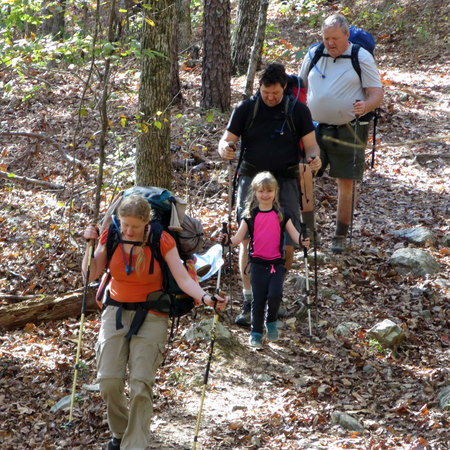
Louisiana Pathfinders Backpacking Trip

Article from the January 2017 issue of the Southwestern Union Record


Louisiana youth from four Pathfinder clubs and two Adventurer clubs went backpacking in early November. Fourteen Pathfinders with four Adventurers and 16 adults backpacked 15 miles along the Eagle Rock Loop Trail in the Ouachita National Forest in Western Arkansas. Participating clubs were the Shreveport Tornados, the Minden Cardinals, the Marthaville Mustangs, and the Baton Rouge Red Sticks. Adventurers from the Shreveport Whirlwinds and the Baton Rouge Red Twigs also completed the trip.

These Pathfinders and Adventurers spent most of September and October learning about backpacking and preparing for this hike. David Grant organized the trip, selected the location and taught the necessary skills needed to survive. He stressed the importance of being prepared and of bringing what was needed but not carrying unnecessary items.


The group reached Winding Stairs, the beginning point of the hike, on Friday afternoon. The group set up their camp and prepared supper. That evening as the group sat around their camp fire, Bill Grant led out in the evening vespers. He discussed the stars and that Jesus would return through the open space in the Orion nebula. As the group hiked the trail on Sabbath, John Anderson and David Grant talked about Jesus saying that, “my yoke is easy and my burden is light.” They also discussed the difference between choosing a hard path and an easy path. Another topic of discussion was the importance of teamwork and of being a part of the church. During Sabbath evening vespers, Bill Grant led out as the kids discussed their favorite parts of the trip and God’s creative power.

After a second night under the stars, the group finished the last leg of their fifteen-mile journey. At the end of the rigorous hike, the young people enjoyed playing in the water of Little Missouri Falls. Those on the trip completed the hiking requirement of the backpacking honor: “participate in a weekend backpack trip of at least five miles to a site not accessible by a vehicle and cook your own meals.” They also completed the hiking requirement of the pioneering honor: “with an experienced leader, participate in a two-day, 15-mile backpack trip, carrying all needed supplies.”

Sophie's Journey - Chapter 31- Lost in the Willows

 Sophie's Journey - Chapter 31 Lost in the Willows The ringing of axes traveled through the encampment. Anne stirred, pressing close to ...