Thursday, October 14, 2021

Roxie Moll Memorial Service


When I was growing up, I attended a small church with my family. The small church shared a pastor with another church. Sometimes when the pastor wasn’t there for the mid-week prayer service, those in attendance would be asked to recite a favorite text. Being somewhat of a smart alec, I thought it was amusing to say that my favorite verse was the shortest verse in the Bible, John 11:35 – “Jesus wept.”

As an adult, it has become a favorite verse of mine. I believe the simple words, “Jesus wept,” may reveal as much about Jesus as any other words ever said about him.

I’m sure that you remember the story of Lazarus. When he became ill, his sisters sent a message to Jesus telling him, “Lord, the one you love is very sick.” Jesus chose to wait until Lazarus had died before he came. “When Jesus saw her weeping and saw the other people wailing with her, he was moved with indignation and was deeply troubled. “Where have you put him?” he asked them. They told him, “Lord, come and see.” Jesus wept.”

Let me ask you a question? Why did Jesus weep? Was it because of his love for Lazarus? He knew Lazarus would be alive in a few minutes. Jesus was crying because his friends were sad. Their sorrow moved him. Jesus is painfully aware of your grief. He knows why we are here today. He knows that we are saying goodbye to someone we love. When we cry, He is aware. Psalms 56:8 tells us, “You keep track of all my sorrows. You have collected all my tears in your bottle. You have recorded each one in your book.”

I want you to know that it is appropriate to grieve. Jesus understands our grief, and I believe that just as He cried at the tomb of Lazarus, He cries with us here today. But even as He grieves with us, Jesus holds out hope. When Martha confronted Jesus, telling Him that if He had been there, her brother would not have died, Jesus said to her, “Your brother will rise again.” Martha answered Jesus, “I know that he will rise again in the resurrection at the last day.” Jesus holds out the same hope to us today.

Paul wrote some of the most comforting words found in the Bible in Romans 8:37-39. “In all these things we are more than conquerors through Him who loved us. For I am persuaded that neither death nor life, nor angels nor principalities nor powers, nor things present nor things to come, nor height nor depth, nor any other created thing, will be able to separate us from the love of God which is in Christ Jesus our Lord.

I want you to know for sure today that nothing can separate you from the love of God. Nothing can keep God from loving you. Nothing can keep God from loving Roxie. I want to read that scripture again and personalize it for Roxie.

Roxie is more than a conqueror through Him who loved her. For I am persuaded that neither death nor life, nor angels nor principalities nor powers, nor things present nor things to come, nor height nor depth, nor any other created thing, will be able to separate Roxie from the love of God which is in Christ Jesus our Lord.

In 1 John, the Bible says, “we have come to know and to believe the love that God has for us. God is love, and whoever abides in love abides in God, and God abides in him.” Let’s remember how much Roxie is valued in God’s eyes! We are here today to remember Roxie because we love her. But it is also essential to understand how much God loves her. The Apostle John continues, “Dear friends, let us continue to love one another, for love comes from God. Anyone who loves is a child of God and knows God. But anyone who does not love does not know God, for God is love.”

I love that equation. God = love

One of the most beautiful descriptions of love is found in 1 Corinthians 13. “Love is patient and kind. Love is not jealous, it does not brag, and it is not proud. Love is not rude, is not selfish, and does not get upset with others. Love does not count up wrongs that have been done. Love takes no pleasure in evil but rejoices over the truth. Love patiently accepts all things. It always trusts, always hopes, and always endures.”

I know that no one is here today to hear an algebra lecture, but we have the rule of symmetry in algebra: If a = b,  then b = a. So if God = love, then love = God.

Since love = God, if we were to replace love in the passage with God, it would read like this.

God is patient and kind. He is not jealous, does not brag, and is not proud. God is not rude, is not selfish, and does not get upset with others. God does not count up wrongs that have been done. He takes no pleasure in evil but rejoices over the truth. God patiently accepts all things. He always trusts, always hopes, and always endures.” What a beautiful picture of God this paints.  I hope that it makes an impact on you like it did me.

We want to make sense of suffering. Why does a loving God allow such pain to continue in this world? I know that while there are no words that can stop the pain today, there are words that give us hope. In 1 Corinthians 1, Paul tells us that “we can see and understand only a little about God now, as if we were peering at his reflection in a poor mirror; but someday we are going to see him in his completeness, face to face. Now all that I know is hazy and blurred, but then I will see everything clearly, just as clearly as God sees into my heart right now.”

Even if I only understand a little about God now, there is comfort in realizing that God loves Roxie, and He loves you. There is comfort in remembering how Roxie touched our lives and made them better. And there is comfort in the words Paul wrote to the Thessalonians. “I do not want you to be ignorant, brethren, concerning those who have fallen asleep, lest you sorrow as others who have no hope. For if we believe that Jesus died and rose again, even so God will bring with Him those who sleep in Jesus. For this we say to you by the word of the Lord, that we who are alive and remain until the coming of the Lord will by no means precede those who are asleep.  For the Lord Himself will descend from heaven with a shout, with the voice of an archangel, and with the trumpet of God. And the dead in Christ will rise first. Then we who are alive and remain shall be caught up together with them in the clouds to meet the Lord in the air. And thus we shall always be with the Lord. Therefore comfort one another with these words.”


Wednesday, October 13, 2021

Harris Creek Trail

My An Arkie's Faith column from the October 13, 2021, issue of The Polk County Pulse.

The warm Indian summer sun lit up the countryside as we headed out in my cousin’s new Jeep for an outdoor adventure. We made plans to eat lunch at Baja Rios and then continue to the Cossatot River State Park. I had hiked the Harris Creek Trail at the State Park several times and wanted to do the hike again. The trail is a 3 1/2 mile loop that follows along Baker Creek and Harris Creek and has a breathtaking overlook of the Cossatot River.

The four of us happily chatted, as we hadn’t seen much of each other for quite a while. While we were driving down Highway 71 into Potter, the SUV in front of us started behaving erratically, moving across the centerline into the oncoming lane and then suddenly correcting back into its lane. Just as we got to the bridge coming into Potter, there was a tremendous bang as the SUV crashed into the guardrail, then spun around and slammed into the guardrail on the other side.

As soon as the Jeep stopped, my wife jumped out of the car and rushed to the scene. The SUV was severely damaged, but a woman got out and was able to walk over to the guardrail and lean against it. I reached for my phone to call 911, but the call did not go through. I kept trying, and on the third try, the call went through. I explained what had happened, and the 911 operator assured me that someone would be right there. While I was making the 911 call, my cousin was clearing debris from the accident off of the road. The entire suspension had been ripped out from under the SUV and blocked the road.

My wife talked calmly and quietly to the woman. She said that she was OK but appeared to be injured. My wife tried to get her to sit down, as she seemed to be going into shock. As vehicles made their way around the accident scene, my wife shouted at several cars, asking if they had a blanket or towels, but no one stopped.

In just a few minutes, law enforcement and the ambulance were on the scene. My wife talked to the sheriff’s deputy and the ambulance driver and told them everything she knew. As my wife got back into the car and we headed south, everyone was visibly shaken, and the mood in the Jeep had gone from cheerful to somber. A short while later, we saw a car driving too fast down a side road, and we weren’t sure that they were going to stop at the highway. After you have witnessed an accident, you are on high alert and notice everything about your surroundings. Before the accident, we had been carefree, visiting and having a great time. But the accident changed the mood in the Jeep

The conversation turned to stories of close calls that each one had experienced. When you have a close call or you witness an accident, it sticks in your mind. It’s not something that you soon forget. By the time we pulled into the Baja Rios parking lot, our nerves had settled a bit, and our hearts weren’t racing quite as fast, but the accident we had witnessed but still on our minds.

We had a wonderful meal at Baja Rios. Their chile relleno covered in white queso with a side of hot green salsa is one of my all-time favorite meals. The daughter of an old friend of mine sat at the table next to us and recognized me. We reminisced about my friend, and I remembered how we could have deep discussions about things we didn’t necessarily agree on and remained good friends. 

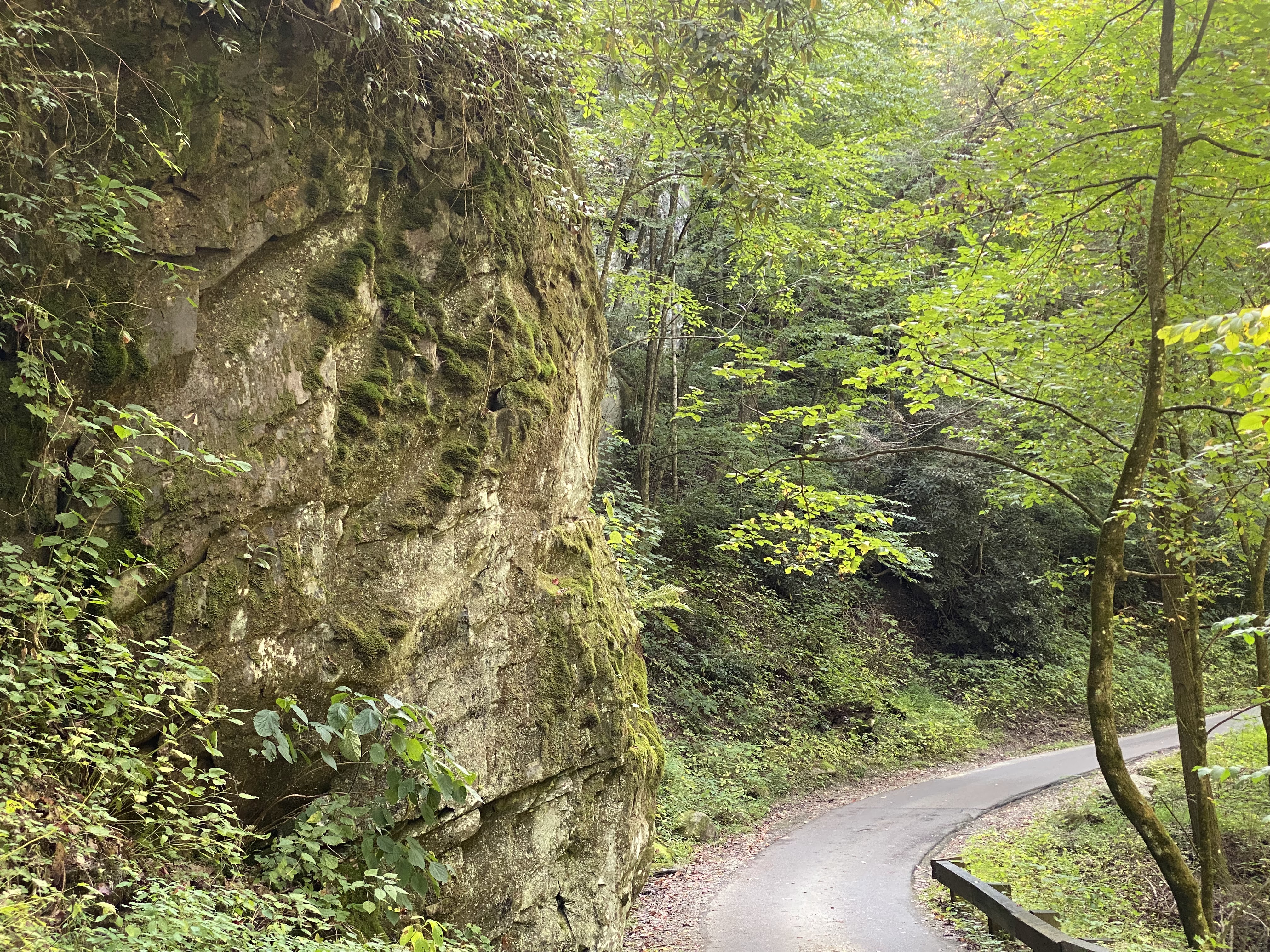
After a great meal, we needed to work off some calories, so we headed down to the Cossatot River State Park to hike the Harris Creek trail. After finding a shady spot to park the Jeep, we started our hike. The trail begins in an old shale pit. There are areas covered in moss, and the color contrast between the light green mosses and black shale is stunning. As the trail begins to climb, you get views of Baker Creek. Once you get to the top of the hill, after an elevation gain of over 300 feet, the trail takes you through an open stand of hardwoods with glimpses of Baker Creek to your left.

Further down the trail, Baker Creek runs into Harris Creek, and there are some fantastic overlooks. The views along the trail are breathtaking. Some sections are steep and rugged, but the trail is well maintained and well marked. The day was hot, but there was usually a breeze to help cool us. By the time we made it back to the Jeep, we were tired and sweaty. 

After our hike, we drove the Jeep on many back roads between Highway 278 and Highway 246 before making our way home. It had been a wonderful afternoon filled with good food, family, and experiencing the natural beauty of our area. But we couldn’t help but wonder about the woman in the accident. How badly had she been injured? We had experienced a lovely day, but the accident had ruined her day. 

God wants us to have beautiful experiences like we had hiking the Harris Creek Trail. Jesus tells us, “I came to give life with joy and abundance.” John 10:10 (VOICE) But we all know that life has its ups and downs, and every day isn’t filled with joy. Some days are difficult. God wants us to help each other through those difficult times. We are to “show kindness and compassion toward each other.” Zechariah 7:9 (NABRE) Compassion is simply a kind, friendly presence in the face of a difficult time. Compassion starts with the understanding that everyone you meet is fighting their own battles. That frame of mind makes it easier to treat others with love, compassion, empathy, and understanding. We are all facing challenges.

Gentle Reader, we can’t heal the world today, but we can begin by showing compassion. So many of the problems in our world stem from a lack of compassion. If we would show kindness to others even when we disagree with them, it could help change our world, one compassionate act at a time. In 2 Corinthians 1:3 (NIV), Paul gives God this title, “the God and Father of our Lord Jesus Christ, the Father of compassion and the God of all comfort.” I love that description of God; “the Father of compassion and the God of all comfort.” And Paul goes on to say, in verse 4, that God “comforts us in all our troubles, so that we can comfort those in any trouble with the comfort we ourselves receive from God.” Do you have compassion for others? Who do you need to comfort today?


Wednesday, October 6, 2021

Buffalo Point

My An Arkie's Faith column from the October 6, 2021, issue of The Polk County Pulse.

“Wake up, wake up,” my sister-in-law hollered up the stairs to the loft. “I hate to wake you, but you have to see this.” I sat up in bed and rubbed the sleep out of my eyes. Looking out the windows that stretched across the entire end of the cabin, I saw an incredible sight. 

It was the last week of September 2020, and we were staying at the Wildwood Cabin high atop a mountain north of Ponca, Arkansas. Perched on a hillside, so high up on stilts that the deck is in the treetops, the cabin seems straight out of a fairy tale. Oversized windows provide a sweeping view of the upper Buffalo River wilderness. 

As I lay in bed looking out over the Buffalo River valley, the sun was coming up. The orange glow created a canopy over the valley that stretched out below the cabin. White clouds filled the valleys, and it looked like a white ocean stretching out as far as my eyes could see. The wispy tops of the clouds added to the illusion of looking out over a body of water. I quickly dressed and went down the stairs and out onto the deck. I tried to soak in all the incredible beauty in front of me.

After a difficult spring and summer, we were on our first out-of-town trip since the Covid-19 outbreak. We visited our favorite place in Arkansas, the Ponca – Jasper area of the Buffalo River. With the beautiful sunrise and the otherworldly view from our cabin, I knew that it was going to be a great day. Today we were going somewhere we had never been before, the lower section of the Buffalo River. 

After spending a couple of hours at the old, abandoned mining town of Rush, we headed to Buffalo Point. When we arrived, we pulled into a parking spot and got out of the car. The views of the river and bluffs were terrific. The large bluff at Buffalo Point is named Painted Bluff. It gets its name from the water seeping over the top portion of the bluff that darkens the rock giving it a painted look.

After taking in the spectacular view, I started walking down the steep path to the water’s edge to get a better look at the bluff. After taking only a few steps, my phone buzzed, alerting me that I had received a text message. I was surprised because there was no cell service, but I had a new message. As I read the text, I couldn’t believe my eyes. It said, “Hey there! You might not remember me, but I was the editor at the Star a couple of years ago. I’ve moved back to town, and the Pulse offered me a job as editor. I’ve been here for about two months now. In that time, I’ve noticed your column is no longer in the Star. I was really disappointed with that because I really enjoyed your column. I’d be thrilled, as I know readers would, if your thoughts were circulating again. I hope you’ll consider sharing your thoughts with the Pulse and let me know if it is a possibility.”

It had been over six months since I had written anything. I had gone from writing every time I had a chance to writing almost nothing. When Covid sent the world into a tailspin in March of 2020, the Star significantly reduced the size of the paper. The column that I had been writing for over four years was one of the casualties. Like many other people, the pandemic turned my world upside down. I felt like nothing would ever be right again. It seemed like I was trying to swim upstream through molasses. This trip to the Buffalo River was starting to give me a new lease on life. 

When I told my wife about the text message, she said, “that is an answer to my prayers.” “What do you mean,” I replied. “I have been praying that you would be inspired to write again,” she answered. I immediately knew what I should do and quickly sent a text message back that said, “I would love to write for you.” With a new reason to write, I had an article finished in a couple of days, and my column An Arkie’s Faith debuted in the next week’s issue of the Pulse.

Writing again lifted me out of a dark place filled with lethargy and depression. With a reason to write and a weekly deadline, I started looking for the positive things around me instead of focusing on the craziness that still flooded the world. We can never know what might have been if something in our lives had never happened, but I am sure that the text message that I received while looking at the breathtakingly picturesque Painted Bluff changed my life for the better. I know that fifty-plus articles, 60,000 words, and a new book exist because of that text.

Most people don’t feel that they can make a difference. What can just one person do? But we never know the difference our actions may make in someone’s life. Jude 1:22 (NKJV) says, “And on some have compassion, making a difference.” You can make a difference. You can have compassion. You may not be able to change the world, but you can make a difference to someone. John F. Kennedy said, “one person can make a difference, and everyone should try.” In Zechariah 7:9 (GW), God tells us to “be compassionate and kind to each other.” Imagine what a difference you could make by simply being kind and compassionate to others.

Look for opportunities to help others and thank those who have helped you. Your gratitude is an act of kindness toward others and can have a profound impact. Paul understood this when he wrote in 1 Thessalonians 5:11 (NIV), “Therefore encourage one another and build each other up.” Paul’s words made me wonder about the words I say. Do I say kind, encouraging, inspiring words to others?

Gentle Reader, I want to publicly thank Jeri for sending that text and the Pulse for allowing me to share my thoughts with you. I want to thank everyone who reads An Arkie’s Faith, especially those who have contacted me and encouraged me. When we encourage and help others, we are showing God’s love. What about you? Is there someone in your life who needs to know how much you care for them? Is there someone who would benefit from kindness, encouragement, and a thank you? Why don’t you make sure to do it today? 


Wednesday, September 29, 2021

Happy Birthday

My An Arkie's Faith column from the September 29, 2021, issue of The Polk County Pulse.

The sun shone softly, and an occasional oak leaf drifted down onto the freshly mowed grass in my backyard. Across the yard, large letters proclaimed Happy Birthday. As I looked out over the deck and patio, I felt a sense of satisfaction. Everything was ready for my Daddy’s 85th birthday celebration. We had worked hard for two days preparing for the party, and guests would be arriving soon. 

Before long, family members from Missouri, Texas, Louisiana, and Kansas were eating, visiting, laughing, and wishing Daddy a happy birthday. Kids were playing in the yard as they got to know cousins who they had never met before. Family, who hadn’t seen each other for quite some time, were catching up over plates heaped with food. After everyone was full, three birthday cakes were brought out; one for Daddy and cakes for my two granddaughters whose birthdays were very soon. After presents were opened, people visited long into the evening. 

As I finally sat down, tired and weary, but still basking in the glow of the beautiful day spent with family, my mind began to wander. I thought about other birthday celebrations I had attended. I wondered how the tradition of celebrating birthdays with parties and gifts began. Have you ever thought about why we celebrate birthdays? When you think about it, they’re just an opportunity for your friends and family to come together and congratulate you for surviving another year. But for some reason, it’s become far more than that.

Although research on the origin of celebrating birthdays is inconclusive, there is enough of a consensus to piece together an approximate history. We learn about the first birthday party on record from the Bible. In Egypt, the Pharaoh was celebrating his birthday. Genesis 40:20 (NLT) tells us, “Pharaoh’s birthday came three days later, and he prepared a banquet for all his officials and staff.” Here we have a mention of a birthday and what seems to be a typical birthday celebration. 

In ancient times, celebrating birthdays was only for kings and other significant people. Wealthy members of Greek society would gather in their spacious villas and share gifts, food, and wishes with their family and friends on specific days. Candles, which were a part of religious offerings and rituals, were part of the celebration.

Like so many of our modern traditions, birthdays have roots in old Greek and Roman traditions. The Greeks and Romans gave us the practice of presents, candles, and parties for birthdays. The Romans were the first to celebrate the birth of the ordinary person. Before the Romans, only kings and rulers celebrated birthdays. However, Roman citizens would celebrate the birthdays of their friends and family members. Any Roman turning 50 years old would receive a special cake baked with wheat flour, olive oil, grated cheese, and honey. 

During the Middle Ages, most European Christians had a patron saint, which they celebrated annually. During this time, kings and other rulers celebrated their personal birthdays, using it as an excuse to hold tournaments, celebrations, feasts, and bask in their subjects’ adoration.

During this time, ordinary Europeans celebrated their patron saint’s feast day. The saint’s birthday was adopted as their own birthday and marked accordingly. Christians used the old Roman and Greek traditions of candles, gifts, gatherings, and offerings in their new traditions.

As the Reformation swept through Europe, a new idea of individualism brought about the beginning of the modern birthday. With new ideas of personal freedom, people started celebrating their own birthday rather than the day of their saint’s birth. As modernization, individualism, and wealth continued to spread through the seventeenth, eighteenth, and nineteenth centuries, so did the idea of celebrating one’s birthday. This gradual growth of birthday traditions continued into the twentieth century where it became nearly universal. Even if modern people don’t go all out in celebrating their special day, everyone knows what their birthday is and acknowledges it when it comes around every year.

What started as an ancient tradition for monarchs to celebrate their closeness to the gods turned into widespread religious ceremonies before becoming a day to celebrate one’s birth. Next time you celebrate your birthday, or the birthday of a close friend or family member, remember that the tradition stretches back thousands of years and has a long and winding path from the mists of time to the present day.

Birthdays are a wonderful experience. They are a moment we celebrate the anniversary of our birth and give thanks for another year of life! They are an opportunity to show our love to family and friends by sharing heartfelt gifts and words of appreciation. But most of all, birthdays are a reminder of how much our heavenly Father loves us. He brought us into the world, knowing us even before our conception. God told Jeremiah, “I knew you before I formed you in your mother’s womb. Before you were born I set you apart.” Jeremiah 1:5 (NLT)

David expressed it this way; “You made all the delicate, inner parts of my body and knit me together in my mother’s womb. Thank you for making me so wonderfully complex! Your workmanship is marvelous—how well I know it. You watched me as I was being formed in utter seclusion, as I was woven together in the dark of the womb. You saw me before I was born. Every day of my life was recorded in your book. Every moment was laid out before a single day had passed.” Psalms 139:13-16 (NLT)

Gentle Reader, birthdays remind us of our beginnings with God. He set us apart for His purposes. We were born to live for God. Although birthday celebrations aren’t commanded or prohibited in the Bible, Psalm 90:12 (ESV) says, “teach us to number our days that we may get a heart of wisdom.” On your next birthday, I hope you will be able to say to God, “I have relied on you from the day I was born. You brought me safely through birth, and I always praise you.” Psalm 71:6 (CEV)


Wednesday, September 22, 2021

Selling the Brooklyn Bridge

My An Arkie's Faith column from the September 22, 2021, issue of The Polk County Pulse.

The iconic Brooklyn Bridge looms majestically over New York City’s East River, connecting the two boroughs of Manhattan and Brooklyn. Construction on the bridge started in 1869 but wasn’t completed until 1883. Thousands of Brooklyn and Manhattan residents witnessed the dedication ceremony, which was presided over by President Chester A. Arthur and New York Governor Grover Cleveland. Within 24 hours, more than 150,000 people walked across the Brooklyn Bridge. It was the first steel suspension bridge and had the longest span of any bridge in the world: 1,600 feet from tower to tower.

The bridge became an essential landmark of New York City and one of the city’s most recognizable symbols. With its unprecedented length and two stately towers, The New York press stated that it was the “eighth wonder of the world.” When the Brooklyn Bridge opened, pedestrians had to pay a penny to cross by foot; the toll for a horse and rider was five cents and ten cents for a horse and wagon. Tens of thousands crossed the bridge every day on the way to work from Brooklyn to Manhattan. Under pressure from civic groups and commuters, the pedestrian toll was repealed in 1891.

One New Yorker, George Parker, was particularly obsessed with the Brooklyn Bridge. He saw the bridge as an opportunity to make money. He decided that he could sell the Brooklyn Bridge to unsuspecting tourists and immigrants. As outrageous as that sounds, his scam worked, as it is reported that he sold the bridge twice a week for years.

Like many others of his time, con artist George Parker preyed on the vast waves of immigrants arriving in America, hungry for their piece of the American dream. He paid stewards working on ships coming into Ellis Island to identify potential “customers.” They scoped out passengers with plenty of cash and an interest in owning real estate. New York in the 1880s was a melting pot of immigrants arriving in the New World from all corners of the globe. Most came in impoverished, but some arrived with investment capital, eager to live the American dream.

The Brooklyn Bridge had several characteristics that made it particularly well suited for this sort of con. Its proximity to the port made it highly visible to newcomers who might be likely marks, and its size provided opportunities to show it off while avoiding the law. But perhaps most critical was its fame. In the late 19th century, the bridge along with the Statue of Liberty was one of the two best-known symbols of America.

The idea behind the sale of the Brooklyn Bridge was that the new owners could erect toll booths and charge people to cross. Parker would sell the bridge, and the unsuspecting buyer would receive nothing more than a forged set of ownership papers. Parker’s swindle became relatively sophisticated over time. He reportedly opened real estate offices and produced authentic-looking documents to prove that he owned the bridge. He convinced his buyers that he enjoyed building bridges but operating them was too stressful for him.

Parker was convicted of fraud three times. After his arrest in 1908, he escaped the courthouse by calmly walking out after donning a sheriff’s hat and coat set down by a sheriff who had walked in from the cold outdoors. After his fourth conviction on December 17, 1928, the judge sentenced him to a mandatory life term at Sing Sing Prison. He spent his last eight years incarcerated and was popular among guards and fellow inmates who enjoyed hearing of his exploits. 

Between fake news, fake products, and stolen identities, our world has no shortage of con artists. Many use versions of scams that are hundreds of years old. I’m sure you have experienced some scams such as Nigerian money scams, fake IRS communications, bogus emails phishing for your personal information, or social media direct messages that appear to be from a friend. The list goes on and on. The people behind these scams are playing a numbers game, cashing in by exploiting their marks vulnerabilities. 


In a recent Reader’s Digest article about scams, Lauren Cahn writes, “the messages vary, but all are designed to prey on our human vulnerabilities, including, the desire to be a ‘hero,’ the desire to appear ‘generous,’ the desire to win ‘free money,’ the desire to be loved and admired, or the desire to avoid shame or punishment.” What these all have in common is an appeal to self. The con man offers a shortcut to the things people crave. One of the vulnerabilities that con men exploit is greed. If it weren’t for the desire to get rich quickly, George Parker would not have been able to sell the Brooklyn Bridge to his mark. If we understand the vulnerabilities, it makes us much less likely to fall for these scams. 

George Parker is one of the most notorious American con men, but someone has conned many more people than George ever did. Jesus talked about this con man in John 8:44 (AMPC). “You are of your father, the devil, and it is your will to practice the lusts and gratify the desires which are characteristic of your father. He was a murderer from the beginning and does not stand in the truth, because there is no truth in him. When he speaks a falsehood, he speaks what is natural to him, for he is a liar himself and the father of lies and of all that is false.” The devil conned many people in Jesus’ time, and many people are still falling for his con today.

Gentle Reader, how can we ensure that we don’t become victims of the most extraordinary con man in history? Knowing how the game works and how it takes advantage of our vulnerabilities is half the battle. Remember that all cons appeal to our selfishness. “So put away everything that is sordid, all that overflowing malice, and humbly receive the word which has been planted within you and which has the power to rescue your lives.” James 1:21 (NTE) Don’t let anyone sell you the Brooklyn Bridge.


Wednesday, September 15, 2021

The Ephraim Bales Place

My An Arkie's Faith column from the September 15, 2021, issue of The Polk County Pulse.


After a long day of driving across Arkansas and Tennessee, Daddy and I were rewarded with the beautiful scenery of the Great Smoky Mountains National Park. To avoid the heavy traffic in Sevierville and Pigeon Forge, we took the scenic route into Gatlinburg. We were traveling on the Little River Road, a gorgeous winding road meandering alongside Little River. It had been many years since I had visited the Smoky Mountains, and I was excited to be there.

We traveled to Gatlinburg, Tennessee, to attend a weekend seminar hosted by the It Is Written television program. It Is Written has been a staple on American television since premiering in 1956. The weekly program, currently hosted by John Bradshaw, applies timeless truths to everyday life, with many episodes dealing with loneliness, fear, low self-esteem, and spiritual principles. Daddy is a longtime supporter of the ministry and has attended many seminars in the past. Earlier this year, he asked me to take him to the seminar, and I agreed. 

The seminar was at the Park Vista hotel in Gatlinburg. It is set 1,000 ft. above Gatlinburg, and with fourteen floors, the hotel has sweeping views over the city and Smoky Mountains. The hotel is a circular building, and every room has an outside view and balcony. Our room was on the side of the hotel that faced the mountains, and our view was spectacular.

After attending the morning seminar and eating lunch, Daddy and I headed back into the Great Smoky Mountains National Park to explore. We drove a couple of miles from the hotel to the Roaring Fork Motor Nature Trail. The road twists and turns for six miles in a one-way loop that ends up back in Gatlinburg. We stopped a couple of times to enjoy the beauty of the Roaring Fork River. It was a perfect day with moderate temperatures and sunny skies. 

One of the stops that we made was at the Ephraim Bales Place. The main feature on the site is the original “dog-trot” cabin; two cabins placed side by side with space between them and a common roof connecting them. The larger cabin was the living area, while the other was the kitchen. The open area served as a covered walkway between the two cabins, a sitting area during warm or stormy weather, and a passageway for air to flow through to help keep the place cool in the summer. 

The cabin remains as it was when the Bales family lived here in the early 1900s. Ephraim, his wife, Minerva, and their nine children called this small cabin home. It is hard to imagine eleven people crammed into this tiny home, but they managed. The family lived here from around 1890 until the government purchased the land in 1930 for inclusion in Great Smoky Mountains National Park. The original corn crib, barn, and pig pen remain standing as well.

As I walked around the cabin site, I tried to imagine the life of this mountain family. I thought about what it was like growing up here as one of Ephraim and Minerva Bales’ nine children. I tried to visualize what it was like to live in this tiny cabin with ten other people. Ephraim Bales owned 72 acres here. He farmed thirty acres, while the rest remained wooded. Ephraim’s farm was one of many along the Roaring Fork, where families scratched a hard living from a very rocky land.

I wondered why someone would want to live here. It’s not like today, where you can buy a mountain cabin and get everything you need at the store. These people had to get everything they needed out of the land. The valley of the Roaring Fork, where the Ephraim Bales cabin is located, is an extremely narrow, rock-strewn hollow. Rock is more common than soil. The small fields where Ephraim and his family once planted corn remind us of these mountain people’s difficult lives and how hard they worked. Some abandoned fields’ slope is so steep that it is difficult to believe that anyone farmed them. There is an old mountain saying, “oft times a handful of soil was placed between the rocks so the corn could be planted.”

As I thought about the back-breaking work of growing crops on these rocky mountainside fields, I remembered a parable that Jesus taught. “He said: ‘A farmer went out to plant his seed. While he was planting, some seed fell by the road. The birds came and ate all that seed. Some seed fell on rocky ground, where there wasn’t enough dirt. That seed grew very fast, because the ground was not deep. But when the sun rose, the plants dried up because they did not have deep roots. Some other seed fell among thorny weeds. The weeds grew and choked the good plants. Some other seed fell on good ground where it grew and became grain.’” Matthew 13:3-8 (ICB)

Many Christian preachers and writers have discussed this parable of Jesus. It seems that there is often a negative connotation in the discussions. We must not be like the road, the rocky ground, or be among the thorny weeds. I don’t disagree with these applications, but I think that we are missing the bigger picture. The parable is not about the ground; it is about the farmer planting the seed. And the farmer spreads his seed everywhere. The seed represents the good news that Jesus wants to save us. As modern-day farmers, we want the best yield, so we are selective about who we choose to share our good news with. But the farmer in the parable planted seed everywhere.

Gentle Reader, modern farming techniques produce much higher yields than how Ephraim Bale farmed on his rocky fields on the steep hillsides of his farm over 100 years ago. But Ephraim grew crops in a place that modern farmers could not and would not. Were his harvests bountiful? No, they were not. But they were enough to raise a family. We, as Christians, are given the job of planting the seeds of the good news about Jesus. But we are often very selective about who we share our good news with. Jesus tells us to “go into every part of the world. Tell the good news to everyone.” Mark 16:15 (WE) Who will you share your good news with today? 


Wednesday, September 8, 2021

The Banyan Tree

My An Arkie's Faith column from the September 8, 2021, issue of The Polk County Pulse.


I wake up suddenly, not because of any noise or interruption, but it leaves me disoriented. My eyes are open, but I strain to see anything in the darkness. For a fleeting moment, I don’t know where I am. As the cobwebs of my mind begin to clear, I remember that I am in Maui. I fumble around on the nightstand to find my phone. I try to focus my eyes on the screen to see what time it is. It is 3:40 A.M. I roll over and try to go back to sleep, but sleep won’t come. We flew across five times zones on our flight to Maui yesterday, and my internal clock needs recalibrating.

After lying in bed awake for an hour, I get up and dress quietly. Slipping out the front door of the condo into the darkness of the Maui night, I walk to the parking lot and get into my rental car. It is just a short drive to Kahekili Beach, and I park the car and walk down to the beach in the moonlight. As I walk south on the sandy beach, an occasional sneaker wave comes and washes over my feet. It isn’t easy to see in the dim moonlight, so it surprises me when the wave comes in farther than usual. As the water washes the sand from around my feet, I start to lose my balance. After a few times, I learn to stand still when the wave comes, not moving until the water has subsided and the sand is stable again.

Sometime later, after walking around two-thirds of a mile, I reach Lionel’s Point and turn around to head back to my car. The beach ends with a freshwater inlet, and there is no way to continue walking south. When I get back to my car, the first rays of morning light are chasing away the darkness. I will not see the sun for quite a while because 5,800-foot Mauna Kahalawai blocks the eastern sun. I drive toward Lahaina Town, anxious to see it for the first time. As I go down Front Street, I recognize places that I have seen while watching videos of Lahaina. 

In the first light of morning, there is almost no one on the streets. I quickly find a place to park and start walking toward the town center. I pass stores and galleries that will be filled with customers in a few hours. I walk past an old historic home and stop to read the historical plaques that tell its story.

The Baldwin Home is the oldest house still standing on the island of Maui. Reverend Ephraim Spaulding built the original four-room structure between 1834-35. The area offered a direct view of the Lahaina landing and the ocean beyond where whaling ships would anchor. Reverend Spaulding became ill in 1836 and returned to Massachusetts, and Reverend Dwight Baldwin and his wife moved into the home. The couple had eight children, all born in Hawai’i.

As their family grew, so did the house. In 1840, Reverend Baldwin added a bedroom and a medical study. And in 1849, he completed an entire second floor. The home faces prevailing winds from the ocean with large windows in the front. The walls are 24-inches thick, constructed of coral, sand, and lava rock with rough-hewn timber framing. The thick walls and high ceilings help keep the interior cool.

As I walk the grounds of the Baldwin Home, I see remnants of the kitchen’s foundation and firepit in the rear yard. I try to imagine the sights and sounds of Lahaina during those early years when as many as 700 whaling ships came through Lahaina in a year. Captains on year-long whale hunts would rest their crews in Lahaina on their journeys back home. Whaling ships would restock their provisions in Lahaina, staying in there for weeks on end. The sailors were a raucous crowd engaging in long stints of drinking and debauchery. The sailors’ behavior disturbed many Maui residents, and the missionaries such as Reverend Baldwin were very vocal in their opposition to the lifestyles of the whalers.

Just a couple of blocks from the Baldwin House, I see Lahaina’s most famous landmark. Spreading out in front of me is a gigantic banyan tree. It covers an entire city block and is 50-feet tall. I sit on a bench under its branches and take in its beauty and grandeur. Because I have never seen a historical plaque that I didn’t read, I find out that this banyan tree was imported from India and planted in front of the Lahaina Courthouse and Lahaina Harbor in 1873 by the sheriff of Maui and is now the largest in the state. It has a canopy circumference spanning a quarter-mile and covers almost two acres. Banyan trees can cover so much ground because they have roots that grow from outward-extending branches and reach the ground, becoming trunk-like and expanding the tree’s footprint.

In some ways, the banyan tree reminds me of what a community should be. The banyan grows by using aerial prop roots. When a tree is mature, its spreading branches produce hundreds of these roots. Some grow until they reach the ground. There, they anchor themselves and develop into new trunks. Imagine numerous branches with numerous dangling roots that produce more trunks and branches with more dangling roots. Over time you have a whole grove connected, covering a large space.

The more roots the tree puts down, the more it grows. And the more it grows, the branches must have the roots firmly grounded to hold up the heavy branches. Everything is interconnected. Without the roots, the branches would fall. Without the branches, the roots wouldn’t exist. 

Gentle Reader, you need your community, and your community needs you. If the community is to grow and prosper, we all need each other, and we must work together. When we refuse to work together, we will never be a strong community. When our disagreements become more important than our common goals, we can never prosper. Paul describes the Christian community this way, “each one of us has a body with many parts, and these parts all have different uses. In the same way, we are many, but in Christ we are all one body. Each one is a part of that body, and each part belongs to all the other parts.” Romans 12:4,5 (NCV) 

The phrase, “each part belongs to all the other parts,” seems like a good description of a banyan tree. If we want to be a productive part of our community and be like the banyan tree, we need to follow the guidance found in 1 Peter 4:8-10 (Message). “Most of all, love each other as if your life depended on it. Love makes up for practically anything. Be quick to give a meal to the hungry, a bed to the homeless—cheerfully. Be generous with the different things God gave you, passing them around so all get in on it.”


Sophie's Journey - Chapter 31- Lost in the Willows

 Sophie's Journey - Chapter 31 Lost in the Willows The ringing of axes traveled through the encampment. Anne stirred, pressing close to ...