Thursday, February 9, 2017

Folk Mountain Music


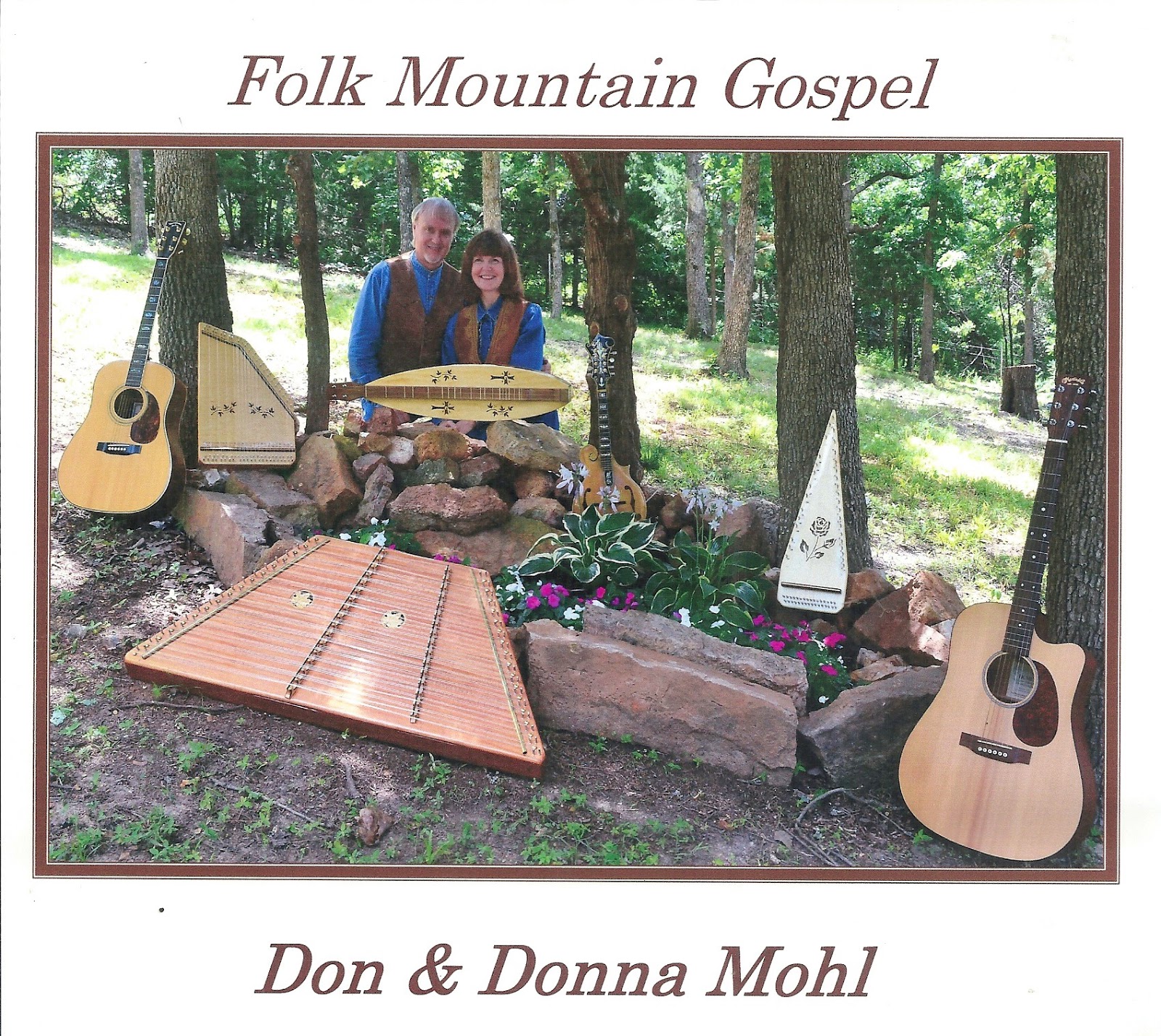
Don and Donna Mohl, performing as Folk Mountain Gospel, will be in concert at the Mena Seventh-day Adventist Church on Fairgrounds Road on Saturday, February 11th at 11:00 A.M. Don and Donna have been traveling around the country since 1988, sharing the love of Jesus through song. Their music is a blend of “mountain” style and folk style gospel. They travel about 25 weekends of the year, which allows them to continue their "day jobs" during the week. They have held concerts in Mena many times over the last 20 years.


Their unique style of music blends biblical and traditional instruments such as the hammered dulcimer, bowed psaltery, zither, mountain dulcimer, mandolin, and guitar with their voices to provide a down-home, family oriented message of the love and grace of Jesus. Don and Donna sing the good old hymns of faith, more recent gospel songs and some songs that they have written related to family values, the grace of Jesus, and the love of God.  Don Mohl hand builds and sells, bowed psalteries, zithers, mountain dulcimers, and hammered dulcimers.

Everyone in the community is invited to attend this free concert. A love offering will be received. For more information about Don and Donna Mohl visit their website at www.folkmountaingospel.com 


Wednesday, February 8, 2017

Saving Moses

My An Arkie's Faith column from the February 8, 2017, issue of The Mena Star.


Some years ago I came home from work one day and my wife met me at the door. "Do you hear that," my wife asked. “Yes,” I answered, “it sounds like a kitten.” Meow, Meooooow, Meooooooooow. “You better go check it out,” my wife said, “it sounds like a kitten is in trouble.”

We walked down the hill to the creek behind our house. The pitiful cries grew louder and louder. They were coming from a small gray kitten. He was caught in a tangle of roots on the creek bank. The kitten was on the far side of the creek. This meant that I had to walk down the creek to a place narrow enough to cross. I found a place where I could wade across the creek; then I fought my way through a mass of bushes and briars. When I finally reached the drenched kitten, he frantically held on to the roots. I had to pull with all my strength to get him out.

I was afraid that the kitten would fight like a little tiger because of how fiercely he had struggled; however, when I held him close, he melted into my chest. Almost immediately I heard a soft, gentle purring. “Hello, Moses,” I said, “your name will have to be Moses because I drew you out of the water.”


What were we going to do with a kitten? Our family had never owned a cat. We had always been dog people. Our dogs have always been pampered pets. Some people have even said that our dogs were the masters of the house. Now we had a tiny helpless kitten. What should we do with it? I guess it was ours.

We carried Moses to our back porch. My wife brought towels and an old pet taxi. We dried him off and made him a soft bed in the pet taxi. I put Moses down, and he immediately climbed my leg, perched on my shoulder, and purred in my ear.

Our back porch became the kitten’s home. He was firmly attached to it. The world beyond the back porch was a strange and scary place and he would not venture into that world. He refused to leave the back porch. If I carried him into the front yard, he would begin desperately clawing, fighting, and freaking out. He wanted down so that he could run back to the safety of the back porch.


When I remember how Moses came into our lives, it reminds me of how my relationship with God developed. I remember being in the creek. In Psalms 69:1-3 (NLT) David wrote about his experience in the creek. " Save me, O God, for the floodwaters are up to my neck. Deeper and deeper I sink into the mire; I can’t find a foothold. I am in deep water, and the floods overwhelm me. I am exhausted from crying for help; my throat is parched. My eyes are swollen with weeping, waiting for my God to help me.”

When Moses the kitten cried out someone came to rescue him. God has made a promise to us. "Call to Me, and I will answer you." Jeremiah 33:3 (NKJV)  When God answers our call, he will bring us to a place of safety.

Moses found a place of peace and safety on the back porch. He knew that as long as he was on the back porch, nothing bad was going to happen to him. God has provided a place of peace and safety for us. "Great peace have those who love Your law, and nothing causes them to stumble." Psalms 119:165 (NKJV) We need to look at God's law the way that Moses looked at the back porch. He realized that the back porch was his place of peace and safety and he wanted to be there. When he was anyplace else, it made him very uncomfortable.


Many times we look at God's law as a jail. We feel that it creates uncomfortable restrictions. We need to ask God to give us a love for his commandments, to instill in us a desire for the peace and safety of His law. No one forced Moses to stay on our back porch; he stayed because he loved the feeling of security. That is how we should view God's law. "Loving God means keeping his commandments, and his commandments are not burdensome.” 1 John 5:3 (NLT)

Just like Moses the kitty found that the front yard was a scary place, many people find the world frightening. It seems like the foundations of our society are crumbling beneath our feet because we are no longer a society that distinguishes right from wrong. God’s commandments are no longer the determination of what is right and wrong. “Christian morality is being ushered out of American social structures and off the cultural main stage, leaving a vacuum in its place — and the broader culture is attempting to fill the void,” reads a recent report by the Barna Group.


Gentle Reader, God’s commandments are like an umbrella. When you stay under the umbrella of God’s commandments, it protects you from many consequences. If you step out from under its protective cover, you suffer the consequences. Be like Moses the kitty and stay in the safety of God’s law. If you do, God promises in Leviticus 25:18 (NIV), “follow my decrees and be careful to obey my laws, and you will live safely in the land.”
Thursday, February 2, 2017

The Edge of Light


My favorite band is Smokey and the Mirror. I have seen them in concert many times. The most recent concert that I attended was last month at South on Main in downtown Little Rock. Because I am so familiar with their music, I always find it interesting to hear a new song for the first time. The South on Main concert was the first time I heard the song, The Edge of Night. I really like the new song.  It was one of several songs that I videoed that night.


Recently Bryan Hembree of Smokey and the Mirror posted a story about the song, The Edge of Night on social media. The story filled the song with new meaning and understanding for me. I contacted Bryan and asked him for permission to share his story on An Arkie's Musings. He graciously agreed. This is his story.

"Last May, Bayard Blain and I got caught on the road in the middle of a tornado on the road to the Kerrville Folk Festival. I was terrified. There I was with my good buddy, in the Sprinter van. Bayard had been a co-pilot and travel partner for at least 50,000 miles in that same van and I had never felt so sure that it might be the last mile. I had visions of 12 beautiful guitars in shards strewn out across the Oklahoma prairie." (Bayard is an amazing luthier who builds beautiful one of a kind custom instruments.)


Bryan continued, "ultimately, we made it through. An answered prayer. The next day I started noodling on a new song. Johann Wagner and I stole away and in an hour we had finished it. Bernice and I just started playing in at our last few shows."

He concluded his post by saying, "may we all find our way out of the darkness. I believe in you. I believe in the human spirit." To that, I add a hearty Amen!


If you enjoy meaningful singer-songwriter music you can listen to Smokey and the Mirror's latest album, Thin Black Line, by clicking here.

Wednesday, February 1, 2017

Finishing the Job

My An Arkie's Faith column from the February 1, 2017, issue of The Mena Star.


A couple of years ago I received a phone call from a customer in Alexandria, Louisiana. He had a 1965 Chevrolet pickup, and he wanted to get it painted. I gave him a price for painting a pickup and didn’t think much more about it. Why would someone from Alexandria have a vehicle painted in Mena?  A few weeks later he called back and said that he was planning to drive the pickup to Mena to drop it off to be painted.

The day that he was supposed to drop off the vehicle, he called and said that he was running late. He had been having some mechanical problems. After several calls with updates on his problems he let me know that he would be in town around 10:00 p.m. We made arrangements to meet at my shop. It was a dark rainy night, but even in those conditions I could see that the pickup was in very rough shape. I considered telling my customer that the condition of his truck was so bad that I didn’t want the job, but he had just driven all day and had so many problems that I couldn’t tell him no. I did tell him that the pickup was in much worse shape than he had described it and that I would take the job with the understanding that I would only work on it when I had no other better-paying jobs in my shop.

The next morning when I inspected the truck in the daylight, my heart sank. It was much worse than I had thought it was the night before. It seemed like every square inch of the body was damaged. Every panel had major dents, and there were large rusted out areas on both doors and both bedsides. This was going to be a very time-consuming project. I contacted the customer and told him all of the problems that I had found but that I would keep my word and paint his truck for the agreed upon price. Because of the terrible condition of the vehicle, I said that I could make no promises about how long it would take. He understood that it would be a fill in project and that I would only work on when I had absolutely nothing else to do.


That was two years ago, and the project still isn’t completed, although I am now close to finishing it. Over the past two years, I have done anything possible to avoid working on this vehicle. My distaste for working on the 65 Chevy has become a standing joke to friends and regular customers who have been watching my “progress” on the project.

I have a job to do, and I have not been diligent about getting it done. I have gone out of my way to do anything else besides working on it. Finishing the job hasn’t been a priority for me.

Jesus has given us a job to do. In Mark 16:15 (NET) Jesus said, “Go into all the world and preach the gospel to every creature.” Our job is to preach the gospel. We need to take our job seriously. Jesus knew what his job was. In Luke 4:42,43 (NET) we read, “the next morning Jesus departed and went to a deserted place. Yet the crowds were seeking him, and they came to him and tried to keep him from leaving them. But Jesus said to them, ‘I must proclaim the good news of the kingdom of God to the other towns too, for that is what I was sent to do.’”

Jesus knew that his job was to proclaim the good news of the kingdom of God and He has passed the job on to those who follow Him. I’m afraid that too often I treat the job Jesus has given me just like I treat the job I have to paint the 1965 Chevrolet Pickup. I have done anything to avoid working on the pickup, and I avoid doing the job Jesus has given me.

We have an obligation to let people know that the kingdom of God is near. “Blow the trumpet in Zion; sound the alarm on my holy mountain! Let all the inhabitants of the land tremble, for the day of the Lord is coming, it is near.” Joel 2:1 (RSV)


From my experience, it seems that the majority of us are not blowing the trumpet. We aren’t doing our job. Why do you think that is? We are to make the message plain. We are to blow the trumpet clear. 1 Corinthians 14:7,8 (NKJV) tells us that, “Even things without life, whether flute or harp, when they make a sound, unless they make a distinction in the sounds, how will it be known what is piped or played?  For if the trumpet makes an uncertain sound, who will prepare for battle?”

I think that a big part of it is that we don’t know what sound the trumpet is to make. And when we do blow the trumpet, it is the trumpet of politics – or social change – or lifestyle, but not the gospel. We blow a trumpet with an uncertain sound.


Gentle Reader, let’s finish the job that we have been given to do; proclaiming the good news of the kingdom of God. Our job isn’t to straighten out the political beliefs of others. Our job isn’t to point out the faults of others. Our job isn’t to prove other religions false. And our job isn't to hate those we disagree with. Our job is to give people the good news found in John 3:16 (NKJV) “For God so loved the world that He gave His only begotten Son, that whoever believes in Him should not perish but have everlasting life.” Don’t get sidetracked, let’s focus on finishing the job.

Tuesday, January 31, 2017

Mesothelioma


Back in 2013, I was contacted by Cameron Von St. James. He came across An Arkie's Musings, and saw that fighting back against cancer was a priority here. He contacted me and offered to tell his story to my readers. We corresponded and he sent me his story. It is both compelling and informative.

I posted his story on An Arkie's Musings and then wrote a blog post that was an update on his story a few month later.

Not long ago I received an email from Virgil Anderson. He came across An Arkie's Musings because of the previous posts about Cameron and Heather St. James. He contacted me and asked if I would write a post highlighting www.mesothelioma.net


Virgil told a bit about himself. He said, "I was recently diagnosed with mesothelioma, which is a cancer caused by exposure to asbestos. From automotive to demolition work, I’ve had many jobs in my life that contributed to my exposure. On some jobs, the air was so thick with debris and asbestos you could taste it in your mouth.

When I was diagnosed with mesothelioma I needed immediate medical attention. Even though I contacted www.mesothelioma.net on a Sunday one of their patient advocates gave me a call back within minutes. They gave me a great deal of helpful information on doctors and resources available to me.

As a result of their website I am now being treated at the National Cancer Institute and the patient advocates have even provided me with financial assistance so I could afford a place to live during my cancer treatments. If I had not reached out to this website I would likely be homeless and more importantly in hospice waiting to die. These people gave me my only chance at survival."

If you or anyone you know is battling mesothelioma please check out the website at www.mesothelioma.net for great information of give them a call at 1-800-692-8608.


Wednesday, January 25, 2017

In the Fog

My An Arkie's Faith column from the January 25, 2017, issue of The Mena Star.


This winter there have been quite a few foggy days. I like a little bit of fog. I like the ethereal, otherworldly way the countryside looks in the fog. Too much fog is another story. One morning on my way to work the fog was so thick that I couldn’t see things that were right beside the road. That wasn’t fun. It can be unnerving to drive in that kind of fog.

One foggy drive that I made was quite memorable. Back in 2000, my wife and I made a trip to Nova Scotia to celebrate our 25th wedding anniversary. We flew into Boston where we met my son-in-law’s uncle who took us on a whirlwind tour of the area including the Old North Church, the USS Constitution, and Buckman Tavern in Lexington. He had recently traveled to Nova Scotia and told us that we needed to be sure and visit Cape Breton Island. He told us that he had enjoyed driving the Cabot Trail and visiting the Fortress of Louisbourg. He told us to make sure that the day we drove the Cabot Trail wasn’t a foggy day.


In spite of his instructions, the day that we scheduled to drive the Cabot Trail turned out to be an extremely foggy day. I had seen pictures of the Cabot Trail, and it’s incredible views. It is one of the most scenic drives on the planet. I was looking forward to this amazing drive. We saw none of the spectacular scenery; we saw only dense fog. When we arrived at Louisbourg, we attended the Louisbourg Playhouse. In a bit if irony one of the songs they played was “In The Fog.”


I enjoy a bit of fog; it turns the world into a surreal landscape. But driving in a heavy fog can be frightening. It makes you slow down and be very alert. Faith is similar to driving in the fog. As we go through life, we don’t always see what’s right in front of us. Like a drive on a foggy day, life is revealed to us little by little. We can’t see into the future. God wants us to slow down and to make each action carefully and deliberately. He doesn’t want us to get in a hurry. That’s when accidents happen. We have to trust that we will get to where God wants us when His timing is right.

“Faith assures us of things we expect and convinces us of the existence of things we cannot see.” Hebrews 11:1 (NOG) When you have to drive in a heavy fog at night, it is so thick that your headlights can only light a few feet in front of the car. It creates tension and fear. What if there’s something I can’t see? What if the road turns and I miss it? High beams that help you to see far when it’s clear, only make the situation worse. You have to drive slow to feel safe. You have to take your time in getting to your destination. True faith is finding certainty in uncertain times. It is learning to trust God in the patches of fog that happen in everyone’s life.


Faith is believing that God is with you, whatever your circumstances are. Whether life is going smoothly, or you are experiencing the foggiest night of your life. When the foggy night comes, we are not alone. In Psalms 32:8  (NIRV) God makes this promise to you; “I will guide you and teach you the way you should go. I will give you good advice and watch over you with love.”

But why does God allow the fog in our lives? My daughter and her family are planning a trip to California this summer. On of the places they want to visit while they are there is Sequoia National Park. The park is famous for its giant sequoia trees. The Giant Forest in the park contains five out of the ten largest trees in the world.


These trees require fog to survive. The area has very little rain but often has dense fog. When fog hits, water drips off the tree needles, which point down to the ground. The fog is necessary for them to survive.

Gentle Reader, In our lives we need to stay constantly connected to God to survive. If we put our faith in God, we will be okay. The confusion of a foggy night may come, but we can trust that God will guide us through. Don’t panic because you can’t see into the future. Don’t let fear of the unknown unnerve you. God knows your future. He sees through the fog and has promised to guide you. “’For I know the plans I have for you,’ declares the Lord, “plans to prosper you and not to harm you, plans to give you hope and a future.” Jeremiah 29:11 (NIV) Trust God to guide you through the foggy moments to get you where you’re going right on time. “Your word is a lamp for my feet, a light for my path.” Psalms 119:105 (NAB)

Monday, January 23, 2017

Dylan LeBlanc


I recently saw Shreveport, Louisiana native Dylan LeBlanc in concert at South on Main in Little Rock, Arkansas. My favorite band is Smokey and the Mirror. When I found out that they would be opening for Dylan LeBlanc I made plans to attend.

I hadn't heard of him, but before the concert I listened to his newest album, Cautionary Tale. I enjoyed the album with it's stripped down simplicity.


The concert wasn't quite what I expected. I am a big fan of singer songwriters and acoustic music. In this show Dylan had a full band and they were loud. On the album, Dylan's voice is expressive and evocative. His lyrics are deep and personal. In the concert the band overpowered his voice to the point that the lyrics were not understandable. The band was tight but I found myself wondering what a more stripped down quieter version of Dylan LeBlanc would sound like.


The title track of his album Cautionary Tale features Dylan's haunting vocals accompanied by a stripped down arrangement. It is becoming a favorite of mine.


After the concert I watched a YouTube interview of Dylan by Jon Hart at KCPT in Kansas City, Missouri.


While I was listening to the interview I realized that I had heard Dylan's dad in concert. The concert was at the Shreveport House Concert Series at Fairfield Studios.  In March 2013, my son-in-law took us to the James LeBlanc concert for my birthday.

James LeBlanc was born and raised in Shreveport, Louisiana. Throughout his teen years, James started writing songs and playing in several bands. 


James moved to Muscle Shoals, Alabama where he signed his first publishing deal with Fame Music. James first hit single was released by Travis Tritt. The song was entitled “Modern Day Bonnie and Clyde. He also wrote the title cut on Jason Aldean's album, Relentless. His songs have been recorded by artists such as Rascal Flatts, Kenny Chesney, Thompson Square, Gary Allan, Sara Evans, and Martina McBride.  To close out the concert he sang "Where You Are" which was recorded by Rascal Flatts as the first song on their Feels Like Today album.


When he was just a baby, Dylan LeBlanc's mother and father divorced. Until the age of nine, he lived with his mother in Blanchard, Louisiana, a small town in the northeast corner of Shreveport. Working full-time cleaning houses, LeBlanc's mother raised Dylan and his two siblings. At the age of ten, LeBlanc relocated to Muscle Shoals so his father could pursue his musical career as a professional country music songwriter. In Muscle Shoals, Dylan spent late nights watching musicians record at the studios where his father played on sessions for the songs that he wrote.

After a record deal at the young age of twenty, Dylan didn't handle fame very well and according to his website; "he slipped into a blur of booze and self-doubt. Exhausted and damaged at just 23-years-old, Dylan came home to Muscle Shoals, Alabama to write a new life for himself. In between the moments of clarity and a few familiar falls, he also wrote a new album, Cautionary Tale: a collection of shimmering, arresting songs with the same haunting vocals."


Dylan played a couple of songs solo accompanied only by a cello. It was my favorite part of the concert. I recorded the song Emma Hartley from his 2010 debut album, Paupers Field. You can listen to it here.


If you have a chance listen to the album Cautionary Tale, I highly recommend it.

Sophie's Journey - Chapter 31- Lost in the Willows

 Sophie's Journey - Chapter 31 Lost in the Willows The ringing of axes traveled through the encampment. Anne stirred, pressing close to ...