Wednesday, May 25, 2022

Remembering Aunt Opal

My An Arkie's Faith column from the May 25, 2022, issue of The Polk County Pulse.

On December 7, 1941, Japanese forces staged a surprise attack on the American naval fleet at Pearl Harbor, Hawaii. Japanese planes sank or damaged 18 warships and destroyed 164 aircraft in a two-hour surprise attack. Over 2,400 servicemen and civilians lost their lives. The next day, the United States Congress declared war, and everyday life across the country changed.

Candy and sweets were in short supply. In early 1942, the U.S. government established a rationing program that set limits on the amount of gas, food, and clothing each person could purchase. Families were issued ration stamps that were used to buy their allotment of everything from meat, sugar, fat, butter, vegetables and fruit, to gas, tires, clothing, and fuel oil. Sugar became the first food item to be rationed. Wholesalers, retailers, bakeries, and industrial users of sugar were registered for sugar ration books in April 1942.

My Grandpa Lawry had a sweet tooth. Knowing him and his love for sweets, I can only imagine how hard sugar rationing was on him. But even with the wartime rationing, he would manage to bring home candy for his kids every paycheck. Oh, how they looked forward to the days when they knew there would be candy.

When my Grandpa would come home with his precious bag of candy, 13-year-old Opal was in charge of carefully dividing the spoils. The most common candy that Grandpa could purchase was Boston Baked Beans. Opal would conscientiously count out three equal piles, one piece at a time. Bobby and Delbert, aged 5 and 10, would quickly eat their small portion of the candy, but Opal would save hers for later. When she had candy left, and her brothers didn't, she would share her part with them. 

In February 2020, I attended my Aunt Opal's memorial service in Ooltewah, Tennessee. During the ceremony, my Daddy told the story of Opal sharing her candy. His voice cracked with emotion as he remembered her kindness and thoughtfulness. Person after person talked about Opal's concern for others and her selflessness. These things are expected at memorials, where people tend to embellish a person's better qualities. But in my Aunt Opal's case, there was no embellishment needed. She may be the sweetest, kindest, most loving person I have ever known. I can never remember her saying one bad thing about anyone in my entire life.

Life wasn't easy for Opal. She suffered many trials and difficulties. But she seemed to have the capability of handling life's pressures and disappointments with grace and dignity. She was able to follow the counsel of James. "Consider it a great joy, my brothers and sisters, whenever you experience various trials, because you know that the testing of your faith produces endurance. And let endurance have its full effect, so that you may be mature and complete, lacking nothing." James 1:2-4 (CSB) In life, we will have troubles. But instead of thinking that we should live a trouble-free life, it's much better to expect bumps in the road and yet learn how to find joy in them. There's a joy that comes from knowing that God is in control of every single situation in our lives.

Opal spent her life encouraging and inspiring others. She followed the counsel found in Hebrews 3:13 (NIV). "But encourage one another daily, as long as it is called 'Today,' so that none of you may be hardened by sin's deceitfulness." It is easy to find something to bring people down, such as a discouraging word, a disapproving look, or disrespectful actions. Many Christians gossip about the problems of others. But you don't talk about someone to build them up; you do it to belittle them or cast doubt on their character. In Proverbs 12:18 (CEV), the Bible tells us, "Sharp words cut like a sword, but words of wisdom heal."

I'm sure that sometimes in her life, Opal said sharp words. None of us are perfect. But she strived to follow Paul's admonition found in Ephesians 4:29 (NOG), where he wrote, "Don't say anything that would hurt another person. Instead, speak only what is good so that you can give help wherever it is needed. That way, what you say will help those who hear you." And in 1 Thessalonians 5:11 (NIV), "Therefore encourage one another and build each other up."

Opal always seemed content and happy no matter what her circumstances were. She grew up during the Great Depression with very few possessions. Life handed her some financial setbacks. But these words of Paul could have been written by Opal. "I have learned to be satisfied with what I have and with whatever happens. I know how to live when I am poor and when I have plenty. I have learned the secret of how to live through any kind of situation—when I have enough to eat or when I am hungry, when I have everything I need or when I have nothing." Philippians 4:11,12 (ERV)

The secret to contentment is a simple one. It does not require displays of religious fervor. It is just the opposite. Christians who focus their lives on their works are never content. Contentment comes from a simple childlike response to life's ups and downs. "Trust in the Lord with all your heart." Proverbs 3:5 (NKJV)

Summing up my Aunt Opal's life is difficult because she lived such a full life. But I think the words of Jesus found in Matthew 22:37-39 (NLT) are very applicable. '"You must love the Lord your God with all your heart, all your soul, and all your mind.' This is the first and greatest commandment. A second is equally important: 'Love your neighbor as yourself.'" Anyone who knew Opal could see that she loved God with all her heart, and she loved her neighbor as herself.

Gentle Reader, I want to live my life so that when I am gone, I will be remembered for loving God and loving my neighbor. I want to be remembered as someone kind, thoughtful, and encouraging. I want to be recognized as someone content with whatever situation I was in because I trusted God. I want to be remembered as my Aunt Opal is remembered.


Wednesday, May 18, 2022

The Errant Sheet Music

My An Arkie's Faith column from the May 18, 2022, issue of The Polk County Pulse.


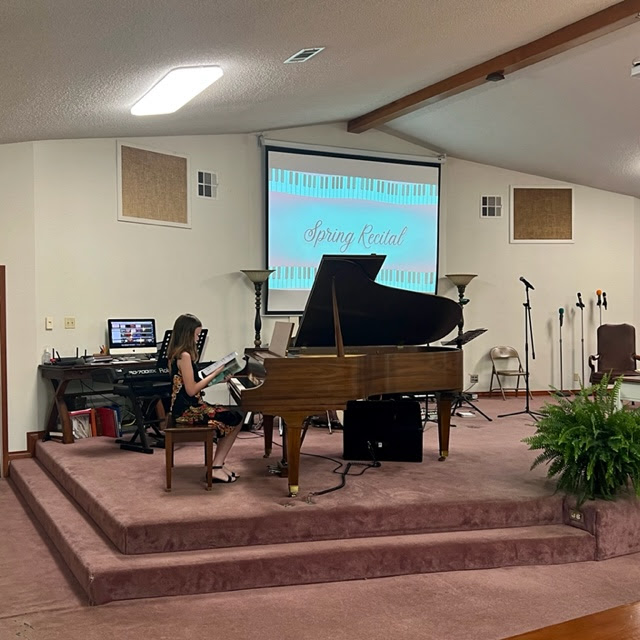
My granddaughters looked beautiful in their dresses as we made our way out the door and headed to the spring piano recital. They had been practicing their recital pieces, and it sounded great to me. I asked them if they were nervous, and they answered, "a little" and "not really." Seeing their confidence and composure reminded me of the years I took music lessons and was always terrified of recitals. But instead of being scared, they seemed excited.

We made our way inside the sanctuary when we arrived at the United Pentecostal Church of Ringgold. The piano students sat in the first two rows, and my granddaughters found their seats with the other students. When the recital began, the twitter of conversation died down, and the room became silent as everyone listened and hoped that each student would play their best. I sent up a silent prayer for each performer, remembering sweating through recital performances as a kid and hoping that no one would experience the panic that I always felt.

My granddaughter, Elisabeth, was second to play in the recital. As she stepped up to the piano and sat down, I slipped from my seat and made my way up the outer aisle to where I could film her. A few seconds after she started playing, the air conditioning came on in the sanctuary. As I filmed, I watched as the air from the air conditioning vent began to rustle the sheet music on the piano. The left side of the sheet music raised off the piano and looked like it might close. I watched the sheet music with a horrified fascination as it slowly waved back and forth. The page moved almost ninety degrees several times before drifting back down into place.

I feared that the distraction of the moving sheet music would cause Elisabeth to stumble as she played, but she handled the situation with a poise and maturity that amazed me. One time I saw a small expression of alarm on her face when it appeared that the sheet music might blow closed, but the page drifted back down as she played on. As the drama of the errant sheet music continued, I breathed a prayer, "please don't let this sheet music spoil her performance and cause her embarrassment." I let out a sigh of relief when Elisabeth finished the piece with no mistakes. Her following two pieces were played beautifully from memory, so there was no way that errant sheet music could spoil them.

After the recital, I talked to my granddaughters and told them I was proud of them. When I mentioned the errant sheet music, I found out that the audience was unaware of the drama. The way the piano was positioned, the errant sheet music could only be seen from where I was filming. No one listening to Elisabeth play had any idea of the difficulties she was experiencing. I thought about how often we see other people and think we know them well, but we cant see their struggles.

While I watched the errant sheet music and listened to the other piano students, I remembered growing up and taking music lessons. I played the trumpet and was in the band. I didn't mind practicing and could always learn to play my pieces correctly, but my nerves would get the best of me when it was a performance. I have terrible memories of botched performances. Once I was scheduled to play a trumpet solo for a church area youth conference. On the way to the meeting, we had car trouble, making us late in arriving. I was so unnerved that I could hardly make a sound with my trumpet. I wanted the ground to open and swallow me.

Have you ever found that something that you can do, have done, and have practiced many times, fails you when you are under pressure? For me, that was my trumpet. No matter how hard I practiced, I would make mistakes when playing for my music teacher or in front of an audience. In my junior year of high school, I transferred to a larger school and was too intimidated to try out for the band. I eventually stopped taking lessons, telling my parents that the pressure was too much. My trumpet sits forlornly in the garage. Now I can barely make a sound.

I recently heard a story that I'm sure never happened. But I liked the story and its application, so I will share it with you anyway. We will call it a parable.

A famous concert pianist was preparing for a show when a group of admirers came to the concert hall. A little boy was there with his mother. He wandered away from her and found himself on a stage with a grand piano. Suddenly the curtains parted, and a spotlight lit the grand piano. The mother looked around for her son and saw him sitting at the piano on stage. He started playing "Twinkle, Twinkle, Little Star." The concert pianist walked up to the boy, put his arms around him, and began playing a counter melody as he whispered, "keep playing; you're doing great." The audience was mesmerized as he played alongside the boy. When they finished, the audience rose in applause.

Paul wrote in Philippians 4:13 (NKJV), "I can do all things through Christ who strengthens me." What we do for God in our own strength is like playing "Twinkle, Twinkle, Little Star" in a concert hall. For us to accomplish anything worthwhile, God will have to be by our side.

Gentle Reader, life is a lot like a piano recital. Whatever we do, people are watching us. While they see our actions, they may never see the errant sheet music that makes us panic. The best thing we can do is ask God to lead our lives. God will sit down beside us and turn our music into something beautiful. Jesus tells us in John 15:4 (NCV), "Remain in me, and I will remain in you. A branch cannot produce fruit alone but must remain in the vine. In the same way, you cannot produce fruit alone but must remain in me."

----------------------------------------------------------------

Watch Elisabeth and the errant sheet music

Wednesday, May 11, 2022

In the Swamp

My An Arkie's Faith column from the May 11, 2022, issue of The Polk County Pulse.

The sun shone brightly as we drove towards Bayou Black in Gibson, Louisiana. Our destination was Bayou Black Airboat Swamp Tours. An airboat swamp tour has been on my bucket list for many years, and today I was going to fulfill that wish. We made our way down a dirt road past the Greenwood Gator Farm with our Hyundai dragging across the tall speed bumps. A gravel parking area and a dilapidated dock were at the end of the road. We parked the car and walked to the pier to wait for our tour.

Even though it was only April, the Louisiana sun beat down on us as we waited. Before the airboat arrived, we could hear it in the distance. The big-block Chevy V-8 and huge propellor were very loud. As the airboat pulled alongside the dock, a ripple of anticipation ran through my body. We climbed aboard the airboat, and the captain handed each one of us a pair of noise-reduction ear muffs. We slowly made our way from the dock through a channel out onto Bayou Black. The bayou looked like a river with cypress trees draped in Spanish moss all along the banks. 

As we made our way down the bayou, suddenly, the airboat veered into a waterway choked with aquatic plants. But the boat skimmed along on top of the plants that completely covered the water. The sensation was almost like boating on land. As soon as I saw the swamp, I fell in love with it. I felt like I was in a surreal dream. The swamp is a magical place filled with unique wildlife, history, culture, and mystery. 

We made our way deeper into the swamp, and the captain would occasionally stop the boat so that he could tell us about the wildlife and plants in the area. He knew where every alligator's territory was and had named them all. Often the alligator was barely visible among the duckweed, and the captain used a long pole to tap the gator so that it would move and everyone could see it. Great Blue Herons, Great Egrets, and Anhinga were often seen silently winging through the swamp. I was excited to see the colorful Roseate Spoonbills. 

We made our way out of the thick swamp, where the captain had to carefully navigate between the cypress trees into a much more open area. Just off to my right were several very tall dead trees. At the top of one of them was a large nest. An osprey soared overhead, and before long, it landed on the nest. We sat quietly for a few minutes and watched the osprey before heading to another part of the swamp. 

The area we are now in is dark and thick and swarming with birds ruffling in the moss-covered cypress trees. The vegetation is so dense that alligators are hard to spot. Suddenly we burst out onto what seems like land and skim over the tops of plants, grasses, and even flowers. Then, suddenly we are out on what looks like an open lake with beautiful blue water. I can hardly believe my eyes. The captain cuts the engine and lets us sit quietly on the water for a few minutes soaking in the beauty. He tells us that next, he is taking us to a special place where hundreds of birds come to nest this time of the year. As we approach, we see the sky filled with birds. Egrets and herons are everywhere, creating a symphony of cacophony. We spend several minutes watching the scenes before us in awe.

As we leave the birds, we make our way along an area with tall grasses and reeds, then the boat seems like it is traveling on land, and we are following a giant egret as it flies gracefully through the air. The boat stops, and the captain points out a large area of native Louisiana swamp iris. For centuries the iris has been a resident of Gulf Coast swamps and bogs, admired for its airy grace and beauty. The beautiful water iris are in full bloom. 

As the tour is nearing the end and we are racing down Bayou Black, I sit with my noise-reducing ear muffs on, and my mind begins to wander. As I daydream, I think about the general perception that most people have of swamps: Dark, gloomy, creepy, and scary. But I have just spent some of the best hours of my life seeing exquisite beauty in the swamp. "Why are swamps considered so ugly and scary," I wonder? I think back to a comment my wife made. She referred to Pastor John Taylor, who had grown up in Southern Louisiana. He always spoke with such loving memories of the swamp and assured his listeners that there would be a swamp in heaven. "When you get to heaven, find the swamp, and I will be there," he would say. Thinking of what Pastor Taylor had said, my wife remarked, "it is so beautiful; I'm sure there will be swamps in heaven." 

Swamps are necessary and provide a much-needed buffer from hurricanes. Wetlands and barrier islands provide a protective barrier from strong winds and hurricanes: every 2.7 miles of wetlands absorbs one foot of storm surge. Swamps are also natural pollution control. Because swamps remove nutrients, pesticides, and sediments from surface waters, they are called the "kidneys of the landscape" since, like kidneys, they filter out harmful materials. In Job 8:11 (GW), the Bible asks us, "Can papyrus grow up where there is no swamp? Can rushes grow tall without water?

I'm sure that you have heard the political mantra, "drain the swamp." Books and movies depict swamps as spooky, dangerous places. But my wife and I found it to be beautiful. Why the difference? If swamps are so essential and valuable, why are they viewed negatively? The airboat and its captain made the difference between a spooky, scary swamp and a beautiful, bucket list fulfilling tour. If the boat captain had tossed me into the swamp and left me, the swamp would have immediately turned into a terrifying place for me. But when I was seated on the airboat with an experienced boat captain in control, the swamp was beautiful. 

Gentle Reader, the life you have been given is beautiful. But without an experienced guide, it can be scary. You were not created to follow your path through this life alone. Proverbs 3:5-6 (NLT) says, " Trust in the Lord with all your heart; do not depend on your own understanding. Seek his will in all you do, and he will show you which path to take." All of us need a guide. There are so many unknown paths in life; we need an excellent guide to help us know which way to go. Today, ask God to be your guide. Then you can say, "though I walk through the valley of the shadow of death, I will fear no evil; For You are with me." Psalms 23:4 (NKJV) You can feel safe and secure even when life becomes a swamp.

-------------------------------------------------------------------------------

Photos courtesy of Steve Dutcher


Wednesday, May 4, 2022

A-Bear's Cafe

My An Arkie's Faith column from the May 4, 2022, issue of The Polk County Pulse.

After a long day's drive to Houma, Louisiana, our GPS took us to the corner of Bayou Black Drive and Barrow Street, where we spotted the quaint old building that housed A-Bear's Cafe, where we were meeting my brother-in-law and sister-in-law from Washington state. They were in Houma to attend the American Cancer Society Relay For Life of Terrebonne Parish as members of Team Relay Nation. We pulled into the crowded parking lot, and I finally found a place to park behind the old building. 

As we walked into the old house converted into a restaurant, we told the hostess that we were here to meet the group from Relay For Life, and they pointed toward the back room of the crowded restaurant. The room was packed, barely leaving room for the waitresses to serve. We were cramped as people made room for us at the long table. The restaurant was alive, with a down-home, country, family vibe.  

Live music filled the restaurant with the sounds of oldies. The vocalist began singing Neil Diamond's, Sweet Caroline. "Where it began, I can't begin to knowing. But then I know it's growing strong." It seemed like the conversations at our table stopped as everyone listened to the music. There's something about the way the song's bridge builds to a soaring chorus that seemed to grab everyone's attention. "Hands, touching hands, reaching out, touching me, touching you. Sweet Caroline," Then, as if by magic, the group spontaneously filled the musical fill with, "ba, ba, ba," and the vocalist continued. "Good times never seemed so good." And it did seem like good times. The next time the chorus came around, the entire restaurant chimed in with, "ba, ba, ba." 

A-Bear's Cafe has been owned and operated by the Hebert family since 1963. In the 2014 article in the digital magazine Country Roads, Alex V. Cook writes, "Jane Hebert and her husband bought the place that had been the family home of Judge Edward "Jimmy" Gaidry. "I think there were eight or nine kids raised in here," said Hebert. And with a modicum of changes, it remains. A bustling lunch crowd trod the same hardwood floors as have countless hungry Houmans at ABear's for a half a century.

"Fifty-one years, actually," Hebert said. "My husband did all the cooking until about five years back." Hebert is a common enough name in the area that I wondered about the outsider-friendly spelling. "That's what it sounds like," she flatly replied." When Alex asked her how she and her husband got in the business she responded, "My husband was born legally blind, and he was cooking on the quarter boats up in Cameron, around there, and in the early '60s they started enforcing the insurance, and he couldn't pass the regulations. His dad was working at the water plant just around back and saw this for rent, so we took it over. I mean, he could have chosen to settle on disability, but we've always worked."

Albert Hebert cooked in A-Bear's kitchen from the day the cafe opened its doors in 1963 until he was no longer able to in 2010. However, Albert Hebert loved the restaurant so much he continued to visit until 2014 to continue his tradition of sneaking away to talk and joke with the customers.

What is unique about A-Bear's Restaurant is the family-like environment and its relaxed atmosphere. As we were eating, a man in a white shirt walked through the restaurant. He was stopping at tables to visit with people. When he came to our table, I could see that his shirt read, "Mayor of ABears Cafe." As the mayor made his way to our end of the table, he stopped to visit with each person. He asked where I was from, and when I replied, "Mena, Arkansas," he told me of the time he visited Mena and Queen Wilhelmina State Park almost forty years ago. 

As the mayor recounted the story of his visit to the Queen Wilhelmina lodge to attend a truck show, he talked about his wife's fear as they drove up the mountain. The Houma, Louisiana area is very flat, you must drive one hundred miles north to reach an elevation of 100 feet, and she had never experienced a road like the Talimena Drive. As he talked, it was easy to see that he loved his hometown and the surrounding area. His historical knowledge of the area is impressive and he always has an anecdote for any situation. He is proud of his son, Travis, a boat captain who charters fishing expeditions. His clients have included Dallas Cowboys quarterback Dak Prescott, and country music singers Chris Young and Jimmy Allen. 

Along with probably everyone else at our table, I invited the mayor to attend the Relay For Life the following afternoon. When we were ready to leave, I told him that we were now friends since he had visited Mena and I was visiting Houma. He told me, "No, we are more than friends; we are brothers." The next afternoon the mayor, Nat, messaged me, "we will try to head that way in a little while." Nat is the kind of friendly guy to whom it is easy to talk. He is a true ambassador for South Louisiana. He and his wife stopped by the Team Relay Nation booth, and I had another chance to visit and learn more about the area. 

In Ephesians 5:1,2 (AMP), Paul writes: "Therefore become imitators of God [copy Him and follow His example], as well-beloved children [imitate their father]; and walk continually in love [that is, value one another—practice empathy and compassion, unselfishly seeking the best for others], just as Christ also loved you and gave Himself up for us, an offering and sacrifice to God [slain for you, so that it became] a sweet fragrance." It is possible for us to imitate Christ, to represent and communicate His desires and will while we are here on earth. "Now then we are ambassadors for Christ." 2 Corinthians 5:20 (KJV)

Gentle Reader, as a Christian, you are an ambassador for Christ. You represent Christ in your sphere of influence. Your actions speak volumes more to people around you than what you say. We can think that we represent Christ if we often speak of Him to others. But our lives, decisions, what we do, and what we don't do in daily situations speak to others the most. Be an ambassador like Nat, the mayor of A-Bear's Cafe. Be an ambassador for Christ.

------------------------------------------------------------------------------------------

Photos taken at A-Bear's Cafe are used courtesy of Steve Dutcher

Wednesday, April 27, 2022

The Little Studebaker

My An Arkie's Faith column from the April 27, 2022, issue of The Polk County Pulse.

Bob and Leo stood in front of their shop, watching the sunset spread across the western sky. The yellow ball of fire changed to hues of red blended with oranges, purples, and crimsons. The workday was over, and the business they owned, Tri-Town-Service, was closed for the day. But the workday seemed never to be over. They were getting into their 1953 Studebaker pickup and heading from Frederick to Denver. They had vehicles that they needed to bring home.

Each month Bob and Leo attended the Denver Police impound auction. The City of Denver would auction off impounded vehicles. They sold the cars in lots of twenty, with the high bidder buying all twenty cars. All the vehicles purchased had to be removed from the impound lot before the next sale. Bob and Leo had quite a few cars that they needed to get back to the shop, but they could do it only after they had closed for the day. They planned to put one car on a tow bar behind the six-cylinder Studebaker pickup and see if they could get one of the cars to run to drive it home. On this trip, Bob’s Daddy, Ben, was going along. They were going to have Ben steer a car on a chain behind the Studebaker and the car it was towing.

When they arrived at the impound lot, they were able to get an old Mercury started. Bob attached a tow bar between the Mercury and a Buick while Leo hooked his tow bar up to another Buick. By the time they had hooked up and were ready to leave, it was late in the night. The Mercury wasn’t running very well, so Bob said to Leo, “I will go first in the Mercury, so if I have any trouble, you will be behind me and able to help.” The Mercury was sputtering away in the lead with a Buick behind on a tow bar. Next came Leo in the six-cylinder pickup with another Buick in tow, followed by Ben, in an old Chevrolet, pulled on a chain. They were quite a sight as they left the impound lot around one o’clock.

They headed home under the summer night sky luminous with starlight and a full moon. Traffic was light on the Valley Highway, and the little group made their way quickly down the road. Bob had hoped that the Mercury would smooth out and run better while driving, but that didn’t happen. It began to run worse instead of better. When they were still over ten miles away from their shop, the Mercury’s engine sputtered, then stopped. Bob tried to start it again, but the Mercury was done for the night. Bob was still on the highway, moving slowly. He put his arm out the window and motioned for Leo to pull up. Leo downshifted to first gear and pulled forward until the bumper of his Studebaker pickup tapped the Buick that the Mercury was towing. He then slowly accelerated, and the whole group picked up speed. Pushing the Mercury and the Buick, and pulling another Buick and the Chevrolet, the little six-cylinder Studebaker made it the rest of the way home. Leo claimed that he drove in high gear and even shifted the Studebaker into overdrive.

Do you ever feel that, like the little Studebaker, you are pulling more than your weight? I know that many of us think that way. When we are pulling more than our weight, it can drag us down. The little Studebaker made it home, even with four other vehicles depending on it. But the Studebaker wouldn’t hold up under long-term use like that. The website How Stuff Works says, “although you may not see the effects of exceeding towing capacity at first, the gradual wear and tear will lead to eventual failure. The best-case scenario is repeated trips to the repair shop; the worst is a major wreck.” I think that it can be the same way with us. The gradual wear and tear can be detrimental.

I have a customer who always seems to care for her extended family. When she came by to pay for another family member’s windshield, I told her that I noticed she was always taking care of someone. She appreciated that I saw she was pulling more than her weight. When we carry someone else’s heavy loads, we are doing what God has asked us to do. “Carry one another’s heavy loads. If you do, you will fulfill the law of Christ.” Galatians 6:2 (NIRV)

Often, others have heavy loads that are too big to bear alone. They don’t have enough strength, resources, or knowledge to carry the load, and they need our help. Doing for others what they can’t do for themselves shows them the love of Jesus. On the other hand, Galatians 6:5 (NIV) says that “each one should carry their own load.” God wants us to carry one another’s heavy loads, but that doesn’t mean that we should be a burden to others by not being responsible. The Bible ideal is that you help me with my heavy loads, and I help you with yours.

Gentle Reader, the story of the little Studebaker is true, and the names have not been changed. Bob is my Daddy; Leo is my cousin, and Ben is my Grandpa. On that night in Colorado, the little Studebaker pushed and pulled four cars for over ten miles. When situations arise and people need your help, be like the little Studebaker. But you don’t have to do it alone. Psalm 55:22 (MSG) says, “Pile your troubles on GOD’s shoulders— he’ll carry your load, he’ll help you out.” “Cast all your care upon Him, because He cares for you.” 1 Peter 5:7 (MEV)


Wednesday, April 20, 2022

Domira's Gratitude

My An Arkie's Faith column from the April 20, 2022, issue of The Polk County Pulse.

The Facebook Messenger notification popped up on my phone. I opened the app to read the message. It was from Domira, the Ukrainian girl who had spent time in our home back in the 90s. After learning that Domira had made it out of Ukraine and was safe in Germany, she and I had been in contact through Messenger. The message read, “Thank you, Richard, so much for your prayers and support. It means a lot. I can’t even express my words of gratitude.” 

As we messaged back and forth, Domira reminisced about her time in Mena. “Wow, Thank you for your support. I had a flashback of when I came to visit you. I didn’t speak much English, and you gave me so much support and love, and care. I will never forget it. I ate my first Ben and Jerry’s ice cream; it’s still my favorite. Your wife is the kindest woman in the world, who took care of me and even made a red dress for me and bought red shoes. I still remember how they looked. They were the best presents in my life. The shoes were the first new shoes that I ever had. It’s all stayed in my memories, your beautiful house, and movie nights. Your daughter was so loving and caring. That gave me the strength to go through all difficulties in a new country without family, friends, and barrier of language. Thank you, God, for showing me how much he loves me through such a lovely family like yours. May God Bless You in Many Ways!”

Once Domira made it out of Ukraine and into Germany, although a refugee herself, she began helping other refugees find places to stay. When I asked her how my wife and I could help, she said, “the best way to send money is Western Union. I just checked that the system is working. I have online banking in Ukraine, so that means, I can transfer money to people that volunteer. My dear friends and some of my family also there, help with the evacuation and bringing people food and medicine, so I can transfer right away the money to people that I trust, and I know what they do, and they send also video or photos.” 

After the story of Domira’s harrowing escape from the war in Ukraine was published in the Polk County Pulse, several people asked how they could help. While I was in The Coffee Vault in Cove, Tom came up to me and said, “I read about the Ukrainian girl in the paper. Here is some money I would like to get to her.” I told him that I would be sending her some money soon and make sure that she got it. Allen contacted me and wanted to know how to donate. I gave him the information on how to send money to Domira via Western Union. Because of the Western Union fees, Allen sent the money to me, and I added it to Tom’s money and other donations I had received before sending it to Domira.

Earlier, I had sent money from our family to Domira. I messaged her to give her the Western Union information so that she could pick up the money at her location. After picking up the money, she replied, “Thank you so much! Everything went through just fine. I received the money and will send it to my good family. They are in Kyiv, where they volunteer and bring bread and other things to people in need. And now they even have a chance to help the ones who evacuated from Bucha, Irpin and Gostomel, the small towns that were destroyed completely. They are now in Kyiv, and random people took them to their places. I will keep you posted. Thank you for being a blessing to many! Many people didn’t eat bread for forty days because of occupied territory, and all of them had to stay in the basement.”

After sending the money to those still in Ukraine, Domira sent me information and photos showing how the money was used. She wrote, “my close friend stayed in Kiev with his three kids and parents. He stays there and helps many people that are really in need. Yesterday, he went with some friends outside of Kyiv, and all small towns Bucha, Irpin, Gostomel and many others, that were occupied by the Russian army for almost 40 days. They are almost destroyed and many civilians were killed when they were trying to leave, so bodies are all over, just laying on the streets. Just a small percentage of people stayed in their houses in their basements, till the Ukrainian army showed up. So, my friend brought bread, water (they don’t have clean water) and rest of the things. People were just hugging and kissing the bread, especially kids and older people. I can’t watch it without tears.”

After receiving donations for Domira from Tom, Allen, my Daddy, and others, I messaged Domira to tell her that I would be sending the money via Western Union. She replied, “I’m reading it and crying. God answers our prayers. Some German churches delivered food to the Romanian border, but we needed to find money for gas in order to deliver it to Kyiv and now you are sending this message. God does the miracles. Thank you for being such a blessing to our country.”

Domira’s gratitude has been a blessing to me but has also opened my eyes to my own weakness. When I look at my life, I realize that I become ungrateful whenever I am inconvenienced. Paul wrote in 1 Thessalonians 5:18 (AMPC), “Thank God in everything, no matter what the circumstances may be, be thankful and give thanks, for this is the will of God for you who are in Christ Jesus.” I need to work on being thankful no matter what the circumstances may be.

Gentle Reader, “give thanks to the Lord, because he is good. His faithful love continues forever.” Psalms 106:1 (NIRV) One of the ways we can demonstrate our thanks to God is to be compassionate and caring towards those here on Earth. Even small gestures can mean a great deal. “Do not forget to do good and to share with others, for with such sacrifices God is pleased.” Hebrews 13:16 (NIV) Good intentions only go so far. To truly help others, you must act in some way. You must be active in your faith for it to be meaningful. Show your faith and gratitude to God by helping someone today.

Wednesday, April 13, 2022

Domira

My An Arkie's Faith column from the April 13, 2022, issue of The Polk County Pulse.

It was a beautiful fall day in 1994, and we were sitting on the front porch of our new home enjoying the evening. We heard the phone ringing, and my wife got up and went inside the house to answer the phone. Picking up the brick-sized cordless phone, she pushed the talk button and said, “hello.” Our daughter replied, “Mama, I need to talk to you about Thanksgiving. Can I bring someone home with me?”

Our daughter was attending a boarding school in northwest Arkansas. That evening, the dean had come to her with a request. “Domira, a new foreign exchange student from Ukraine, has just arrived at school and doesn’t know anyone yet,” the dean said. “Do you think she could spend the Thanksgiving holiday with you and your family?” “I will ask my parents,” my daughter replied.

When our daughter told us about the foreign exchange student and her need for a place to stay over Thanksgiving, we told her the girl was welcome at our house. Domira spent Thanksgiving with us, and we enjoyed getting to know her and learning about Ukraine. She experienced her first shopping experience in the U.S. at the Mena Wal-Mart. She told us that she would have to go to separate shops for milk, bread, fruit, etcetera at home. When Domira first saw our home, she wanted to know how many families lived there. She was surprised when we told her that only our family lived there.

When Russian troops invaded Ukraine and headed for Kyiv, we were concerned for Domira’s safety. We had kept up with her through social media, but there was no information from her. We were relieved when Domira posted a video telling her harrowing story and letting us know she was safe on the seventh of April. I wanted to share her story with you, my readers. Here is Domira telling her story in her own words.

“Thank you, my dear family and my friends, so much for your support and prayers. It means a lot to me and helped me go through what I went through. I’m sorry I couldn’t answer all your phone calls and messages. I know that it’s not easy to understand everything going on now.

My apartment is located on one of the main streets where everybody gets into the city and gets out. Most of the time, between 6:30 and 12:00, we have a traffic jam because people outside of Kyiv are trying to get to Kyiv to get to work. At 6:30 in the morning on the twenty-fourth of February, everything stopped. Not a single car was trying to get here. But at the same time three lines were just packed; Three lines that wanted to get out of Kyiv. All those cars and buses, everything was just full, and I knew that it was impossible to get out of here by car or bus.

I went to the train station, and it was also full. At the same time, our bank system was shut down, so that means that you cannot buy any tickets online, you cannot pay by card, and you cannot buy any food or anything if you don’t have cash. So everybody was trying to get cash from the bank and we had lines of about 20-30 people who were trying to stay in the line to get some cash.


On the first day, I heard my first sirens. I’ve never heard in my life such a crazy sound. When I was trying to get home, I was almost there. I just needed a couple of minutes to get to my apartment when I heard the sirens; that meant that the bombing was starting the second time. When I looked around, everybody was just in panic, running around trying to find the safest place. Since that time, we have had sirens almost every hour. Sirens mean that somewhere there was a bombing and there were explosions. I could not get home that day. I couldn’t get home to get the most important things. That means that everything you packed in five minutes, everything that you can take with you in just one suitcase or one bag. You pack all your life in five minutes in one bag and just try to go somewhere in a safe place.

I knew that in the same day it was impossible for me to get out of here, and I went to see my friend. She stayed by herself, and she was also scared and panicked, so we stayed overnight there. The next day at 7:30 in the morning, we tried to get out of Kyiv. We heard sirens all night and shooting. We knew that we could not stay here; we had to get out. We knew that it was impossible to get out on the Main Street and the main highway. So we needed to find the small roads and get through the small towns, somehow, someway, to the place where it’s going to be not so far from Romania where it’s safe. We don’t know how we’re going to get there. We don’t have any plan, I guess nobody had, we just needed to go.

We got in the car and started to drive. It took us twenty hours to get to Chernivtsi. We went through small villages and towns on the way. We saw many tanks and military, and sometimes we didn’t even know if it was Russian military or Ukrainian. We drove through small towns and villages, and we drove through the forests and places that had no lights at all. We heard explosions all the time, but we had no idea when we were going to get to Chernivtsi or if we would get there. Because every time you hear an explosion, every time you see a tank somewhere, you don’t know if that’s your last minute, or if you’re going to make it, or if you’re going to still be alive. For twenty hours, it seemed like it was just impossible.

We got to the safe place at about 4:00 o’clock in the morning, and I just wanted to check the news to see what was going on in Kyiv. I saw that just a couple of minutes from my apartment, in the same place where I walked just a few hours before, Russian tanks had destroyed everything that’s around there. I know that I am one of the blessed people; that had a chance to get out and be in a safe place.

I know so many kids and women that were just trying to get out of Kyiv or many other places, and they were shot. They didn’t have a chance. It’s hard to understand and explain what’s going on and why kids were killed, why women were killed, and why they were raped. It’s especially hard to understand why some family members and some of your friends don’t believe you when you tell them what’s going on. I am not going to lose my energy explaining to somebody who doesn’t believe that the war is going on, that people were killed and I was one of them who could have been shot.

I’m just praying with everybody else that Ukraine will survive. We are praying and dreaming about the day when the war is going to stop. We are dreaming about the time when families can reunite. We’re dreaming about the time when Ukraine is going to be rebuilt. But so many people were killed, and you can’t forget that. I know that I can do as much as I can from my side, and I’m trying every single day to support and help people who stayed in Kiev and different parts of Ukraine. If you have a chance to help in any way, if you want to support, you can write me or you can call me. Thank you for your prayers. Thank you that you believe. God bless you.”

Gentle Reader, those affected by the war in Ukraine are not just nameless people. Please pray for Domira and all of the Ukrainians. “First and foremost, I urge God’s people to pray. They should make their requests, petitions, and thanksgivings on behalf of all humanity. Teach them to pray for kings (or anyone in high places for that matter) so that we can lead quiet, peaceful lives—reverent, godly, and holy.” 1 Timothy 2:1,2 (VOICE)


Sophie's Journey - Chapter 31- Lost in the Willows

 Sophie's Journey - Chapter 31 Lost in the Willows The ringing of axes traveled through the encampment. Anne stirred, pressing close to ...