Showing posts with label Civil War. Show all posts

Wednesday, November 27, 2013

Thank God For Grace


We are looking forward to celebrating Thanksgiving with my son and his wife. We will be leaving this afternoon and heading for Conroe, Texas.  The purpose of Thanksgiving is eating until we are stuffed... and giving thanks.  I appreciate the reminder to give thanks for our blessings, but realize that we should be giving thanks 365 days of the year. 

In the U.S. there has been an annual Thanksgiving observed since 1863.  In that year, with the county involved in a horrific Civil War, President Lincoln issued a proclamation declaring a day of Thanksgiving. 

One of the traditions of Thanksgiving is talking about the things we are thankful for.  There are many things, but I am truly thankful for my family.  

The Greek word translated thanksgiving is eucharista.  The English spelling is Eucharist.  My dictionary gives the following definitions.   1.  The sacrament of Holy Communion; the sacrifice of the Mass; the Lord's Supper.  2.  The giving of thanks; thanksgiving.


The word that most people use to describe the Lord’s Supper means thanksgiving.  What a great thought.  The Lord’s Supper is a ceremony in which we give thanks for what Jesus has done for us.  The root word in Eucharist is charis.  Charis is normally translated as grace.  That makes sense.  Think with me for a moment.  What happens at the beginning of your Thanksgiving meal?  Someone says “grace”.  Why do we say that they say grace?  Saying grace is giving thanks. 

At a British conference on religions, experts from around the world debated what, if any, belief was unique to the Christian faith. They began eliminating possibilities. Incarnation? Other religions had different versions of gods appearing in human form. Resurrection? Again, other religions had accounts of return from death. The debate went on for some time until C.S. Lewis wandered into the room.  “What’s the rumpus about?” he asked, and heard in reply that his colleagues were discussing Christianity’s unique contribution among world religions. Lewis responded, “Oh, that’s easy. It’s grace.”


After some discussion, the conferees had to agree. The notion of God’s love coming to us free of charge, no strings attached, is singularly Christian.  Of all the world’s religions, only Christianity dares to make God’s love unconditional.

In 2 Timothy 1:9, the Bible says, “He has saved us and called us with a holy calling, not according to our works, but according to His own purpose and grace which was given to us in Christ Jesus before time began”.

Before you were born there was grace for you.  Thank God for grace!  As wonderful as it is, grace is not well understood and often not really believed. We use the word a lot but rarely think about what it means. It's probably true that most of us think infrequently about God's grace. 

Part of our problem is in the nature of grace itself. Grace is scandalous. It’s hard to accept. It’s hard to believe. It’s hard to receive. We are skeptical when a telemarketer tells us, "I'm not trying to sell you anything. I just want to offer you a free trip to Hawaii." Automatically we wonder, "What's the catch?" because we have all been taught that "there's no free lunch."


Grace shocks us in what it offers. It frightens us with what it does for sinners. Grace teaches us that God does for others what we would never do for them. We would save the not-so-bad. God starts with prostitutes and then works downward from there. Grace is a gift that costs everything to the giver and nothing to the receiver. It is given to those who don't deserve it, barely recognize it, and hardly appreciate it.
Grace means that no one is too bad to be saved. The Bible is full of examples; Liars, cheaters, murderers, adulterers, prostitutes.  God specializes in saving really bad people.

Grace also means that some people may be too good to be saved. That is, they may have such a high opinion of themselves that they think they don't need God's grace. They may admit they are sinners but they don't admit they are spiritually dead.

This view of grace is hard for good people to accept because it means we must give up our "goodness" in order to be saved. We must admit that nothing we have done matters in the least when it comes to being forgiven by God. God has designed our salvation so that he alone gets the glory!

Ephesians 2:8,9 tells us,  “For by grace you have been saved through faith, and that not of yourselves; it is the gift of God, not of works, lest anyone should boast”.

Imagine what heaven would be like if you had to earn your way there. "I was a preacher." "I built churches across the world." "I gave a million dollars to world missions." "I had hundreds of baptisms at my meetings." "I volunteered at the hospital." “I baked cookies for the school kids.” As good as those things are they will not help forgive even one sin. They will not save you or help save you. 


Can you just imagine someone putting his arm around Jesus and saying, "You and me, Jesus, we did it: You died on the cross and I baked the cookies”? I am so thankful that it's not like that. When Jesus died on the cross, he paid the full price for your salvation. Jesus paid the price all by himself.

Grace is never cheap.  Grace costs the ultimate.  It is just that you and I aren’t the ones paying.  “For God so loved the world, that He gave His only begotten Son, that whosever believes in Him shall not perish, but have everlasting life”.  John 3:16


Thank God for grace!   Look for grace in unexpected places. I know that you will find it. Paul tells us in 1 Timothy 1:14, "the grace of our Lord is exceedingly abundant".

Tuesday, October 22, 2013

Old Washington


Washington, Arkansas is a peaceful tree-shaded town and one of the most amazing historic places in Arkansas. The old town still looks like the 19th century with plank board sidewalks and streets that have never been paved.   Most of the town is now a part of Historic Washington State Park.  It is commonly referred to as Old Washington.


In the State Park there are over thirty restored historic structures including classic examples of Southern Greek Revival and Federal architecture, Gothic Revival, Italianate, and the oldest building built of hand-hewn timber.


From its establishment in 1826, Washington was an important stop on the rugged Southwest Trail for pioneers traveling to Texas. Frontiersmen James Bowie, Sam Houston and Davy Crockett all traveled through Washington on their way to the Alamo. Houston planned parts of the revolt strategy in a tavern in Washington during 1834.  James Black, a local blacksmith, is credited with creating the legendary Bowie knife carried by Jim Bowie at his blacksmith shop in Washington.


At the State Park they often have blacksmith demonstrations.  My wife enjoys watching blacksmiths at work. Her Grandpa was born in 1855 and was a blacksmith by trade in Stratton, Colorado. Her Dad said that when he was a boy, you could hear his anvil ringing all over town. When it quit ringing you better get home. It was time for supper.


Washington's history during the Civil War is fascinating.   Following the capture of Little Rock by the Union Army in 1863, the Confederate government moved the state government offices to Hot Springs for short time, then moved the state government to Washington, making it the Capital of Confederate Arkansas from 1863-1865. 


When the railroad was built that connected much of the state with Little Rock, it was eight miles from Washington.  Because it was no longer on the main travel route, Washington began a slow decline. The decline caused by most of the business moving to Hope, Arkansas, which was on the railroad, was the reason that Washington seems to stand still and lets modern visitors go back in time.


The ABC Wednesday Meme is a fun way to see some great blogs.

Tuesday, July 30, 2013

Carnton Plantation


C is for Carnton Plantation.  Recently on our way to Ootelwah, Tennessee for my Aunt's 85th birthday party, we stopped in Franklin, Tennessee.  My sister and her husband from Missouri were also heading to the same party.  We called them to see where they were, and they just happened to be in Franklin.  We got together for lunch at the Franklin Mercantile Deli.  After lunch we toured the Carnton Plantation.

Carnton was built in 1826 by former Nashville mayor Randal McGavock. Throughout the nineteenth century it was frequently visited by those shaping Tennessee and American history, including President Andrew Jackson. Carnton was a working plantation of 1,400 acres of which 500 acres was used to raise wheat, corn, oats, hay and potatoes. After his father died in 1843, John McGavock took possession of the property and continued to farm it until his death. Under his direction, Carnton grew to become one of the premier farms in Williamson County, Tennessee.  John McGavock married Carrie Elizabeth Winder in December 1848 and they had five children during the subsequent years, three of whom died at young ages.  The surviving children were Winder and Hattie.  Here is a photograph of them from 1865.


Beginning at 4 p.m. on November 30, 1864, Carnton Plantation saw one of the bloodiest battles of the entire Civil War. The Confederate Army of Tennessee furiously assaulted the Federal army entrenched along the southern edge of Franklin. The resulting battle was the bloodiest five hours of the Civil War.   The Battle of Franklin lasted barely five hours and led to some 9,500 soldiers being killed, wounded, captured, or counted as missing. Nearly 7,000 of that number were Confederate troops. Carnton served as the largest field hospital in the area for hundreds of wounded and dying Confederate soldiers.

As we toured the home, you could see blood stains on the floors from the surgeries and amputations done during that time.  A staff officer later wrote that "the wounded, in hundreds, were brought to the house during the battle, and all the night after. And when the noble old house could hold no more, the yard was appropriated until the wounded and dead filled that also"


Hundreds of Confederate wounded and dying were tended by Carrie McGavock and her family. Her two children, Hattie (age nine) and son Winder (age seven), provided some basic assistance to the surgeons as well. Over 300 Confederate soldiers were cared for inside Carnton alone. Hundreds more, were spread out through the rest of the property, including in the slave cabins.

Carrie McGavock described the scene at Carnton after the Battle of Franklin this way. "Every room was filled, every bed had two poor, bleeding fellows, every spare space, niche, and corner under the stairs, in the hall, everywhere. And when the noble old house could hold no more, the yard was appropriated until the wounded and dead filled that. Our doctors were deficient in bandages and I began by giving my old linen, then my towels and napkins, then my sheets and tablecloths, then my husband's shirts and my own undergarments"


Author Robert Hicks wrote a historical novel based on the life of Carrie McGavock titled The Widow of the South. A review of the book by Anne Rivers Siddons states,  "A memorable, many-faceted account of one of the definitive events of our history. To read this thrilling story is to encounter and recognize something essential of the worst and best about ourselves. What a wonderful story Robert Hicks has told. It speaks powerfully to us today." I haven't read the book yet but I am planning to.


In early 1866, John and Carrie McGavock designated two acres of land adjacent to their family cemetery as a final burial place for nearly 1,500 Confederate soldiers killed during the Battle of Franklin. The McGavocks maintained the cemetery until their respective deaths. Today, the McGavock Confederate Cemetery is a lasting memorial honoring those fallen soldiers and the Battle of Franklin. It is the largest privately owned military cemetery in the nation.

I really enjoyed touring Carnton and the surrounding gardens.  Our tour guide was very knowledgeable and enthusiastic. If you are ever in Franklin, Tennessee I highly recommend a visit to Carnton Plantation.   Here are a few pictures taken at Carnton.


The ABC Wednesday Meme is a fun way to see some great blogs.

Tuesday, June 11, 2013

Vicksburg National Military Park

Vicksburg National Military Park 15

Last month my wife and I went on a vacation to Disney World in Florida with our daughter and her family.  On our way home we spent a couple of hours at the Vicksburg National Military Park in Vicksburg, Mississippi.

The park commemorates the campaign, siege, and defense of Vicksburg. The city's surrender on July 4, 1863 split the South, giving control of the Mississippi River to the Union. There are over 1,340 monuments, a restored Union gunboat, and National Cemetery on the 16-mile tour road.

Cannon 3

There is so much history in the park. The U.S. Government established the battlefield as a National Military Park in 1899.

The battles of the Vicksburg campaign were some of the fiercest and longest lasting of the war. General Grant attacked the Confederates on May 19, 1863 and again on May 22. The Confederate positions were too strong, and the Union casualties were high. On May 25 General Grant decided on a siege of the city as he had it surrounded and had naval bombardment from the Mississippi. He stated in his memoirs, "I now determined upon a regular siege—to 'out-camp the enemy,' as it were, and to incur no more losses."


By the end of June, half of the Rebel soldiers were sick or hospitalized. Scurvy, malaria, dysentery, diarrhea, and other diseases cut their ranks. Food was almost non-existent, with soldiers resorting to eating dogs, mules and shoe leather. On July 3 General Pemberton rode out of the city with white flags to meet General Grant to discuss terms of surrender.

Cannon

The most important thing for the Union army was that they now controlled all of the Mississippi River. The side that controlled that waterway controlled a direct route through the Confederacy and would eventually dominate the war. The full campaign claimed 10,142 Union and 9,091 Confederate killed and wounded.

As we toured the park and looked at all of the monuments it was sobering to think of the loss of life and the hardship that occurred in this beautiful countryside.

Vicksburg National Military Park 9

Arkansas

Vicksburg National Military Park 7

Vicksburg National Military Park 10

Vicksburg National Military Park 6

Vicksburg National Military Park 2


The ABC Wednesday Meme is a fun way to see some great blogs.

Tuesday, May 21, 2013

St. Marks National Wildlife Refuge


On our way home from Orlando after a recent visit to Disney World we were traveling on I-75 between Ocala and Gainesville when we encountered a slow down. It took us an hour to travel a few miles. At the first exit we could get off, we decided to find an alternate route. The back roads that we took were very pretty with many beautiful horse farms.  

As I was looking at the map, I saw that we would be passing by St. Marks National Wildlife Refuge. It was just a few miles off of the highway that we were on, so we decided to go check it out.


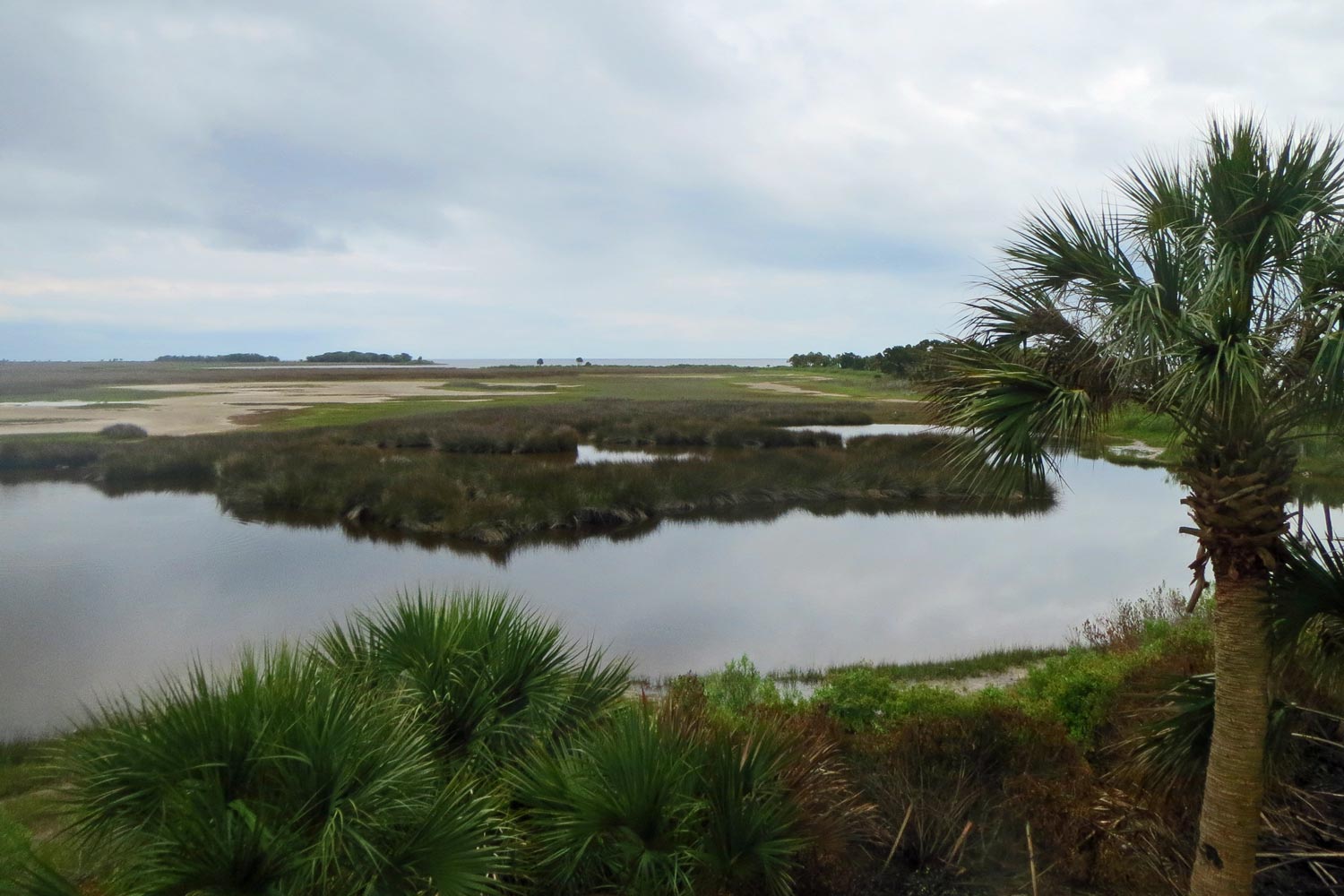
At the visitors center there was a large pond with a trail around it. The pond was located where there had been a sand pit that provided the sand that CCC workers used to build a road out to the lighthouse in the 1930's.  There were flowers in the pond, and an alligator mother with many babies on the bank.


One of the interesting things about St. Marks is that there are four distinct types of landscape in the seven mile drive from the visitors center to the lighthouse on the coast, forest, swamp, inter-coastal waterway and the coast.  


The lighthouse was completed in 1831 and survived destructive hurricanes of the 1840's and 1850's, including the disastrous hurricane of September 1843.  During the Civil War, Confederate troops were stationed near the lighthouse to defend the area against a Union attack. In March 1865, a Union fleet of 16 ships appeared off the coast and began to shell the vicinity of the lighthouse in preparation for landing a force. The Confederates attempted to blow up the lighthouse during their retreat in order to deny it as a lookout for the Union forces. Although they were unsuccessful in destroying the tower,  the damage inflicted was substantial, necessitating a complete rebuild of the tower immediately following the war.  The lighthouse was automated in 1960 and remains today an active aid to navigation for vessels on the Apalachee Bay.

St. Marks was established in 1931 to provide wintering habitat for migratory birds. It is one of the oldest refuges in the National Wildlife Refuge System.  We saw lots of wildlife during our visit including Alligators, Purple Gallinule, and Anhinga.  


St. Marks was a really quiet peaceful beautiful place.  It was such a sharp contrast to the week we had just spent at Disney World. It was a blessing to have gotten off of the interstate and accidentally ended up in such a beautiful place.  We only had time to spend a couple of hours at St. Marks but I really hope to be able to return when I can spend more time.


The ABC Wednesday Meme is a fun way to see some great blogs.

Sophie's Journey - Chapter 31- Lost in the Willows

 Sophie's Journey - Chapter 31 Lost in the Willows The ringing of axes traveled through the encampment. Anne stirred, pressing close to ...